
The United States should strengthen its ties to Ethiopia following unprecedented reforms in the East African nation, a top U.S. diplomat said Wednesday.
Tibor Nagy, the newly appointed assistant secretary of the U.S. Bureau of African Affairs, told members of a House Foreign Affairs subcommittee in Washington that Ethiopia has earned praise for its historic changes.
“Prime Minister Abiy Ahmed has initiated groundbreaking reforms across most every area of Ethiopian society,” Nagy said. “He deserves tremendous credit for his boldness in tackling issues previous governments have not addressed.”
But Nagy also outlined a number of unresolved concerns and urged the United States to continue to engage with Ethiopia, mobilize resources to provide aid and assistance, and maintain dialog with the country’s leadership in the wake of momentous reforms that, nonetheless, remain “quite fragile.”
Eritrea’s ‘re-emergence’
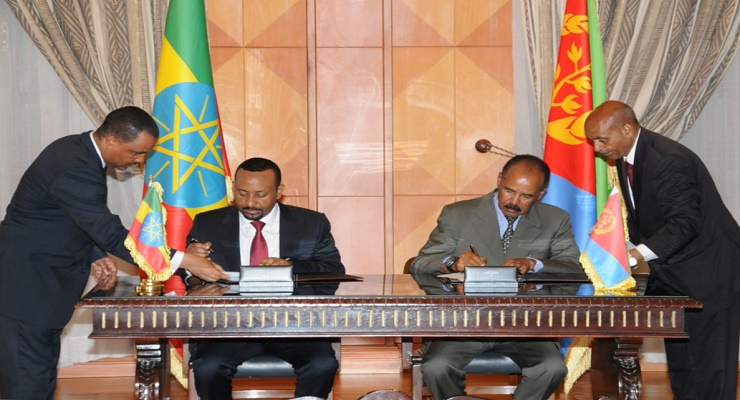
Representative Chris Smith, a New Jersey Republican who is chairman of the Africa, Global Health, Global Human Rights and International Organizations Subcommittee,outlined Abiy’s accomplishments: releasing thousands of political prisoners, lifting a state of emergency and securing peace with neighbor Eritrea.
Officials at Wednesday’s hearing celebrated the July peace deal that ended nearly 20 years of war between Ethiopia and Eritrea, but they expressed concerns about the internal dynamics in Eritrea, a country that has faced U.N. sanctions since 2009 for allegedly supporting the extremist group al-Shabab and a border dispute with Djibouti.
Smith said Eritrea could become a “critical U.S. strategic partner,” and Nagy welcomed “Eritrea’s re-emergence on the regional and global stage.”
But Nagy also expressed “significant concerns” about the countries’ bilateral relationship, citing the Eritrean detention of American citizens, possible arms deals with North Korea and human rights concerns.
“The United States has deliberately engaged with Eritrea in recent months with both these opportunities and concerns in full view,” Nagy said.
Peace with Ethiopia eliminates Eritrea’s reasons to militarize its population, particularly through the use of indefinite forced conscription, Nagy added. And, although the “atmosphere” between the United States and Eritrea hasimproved, he said, concrete actions will need to be taken to introduce internal reforms before sanctions can be lifted.
As a permanent member of the U.N. Security Council, the United States has the power to veto any vote to remove sanctions.
Youth factor
In his remarks, Nagy underscored the importance of Ethiopia’s youth. Some 70 million people — about 70 percent of the population — are under age30, Nagy said, and they have high expectations of their government.
As the country’s demographics shift, many additional people will enter the workforce, emphasizing the need for new jobs.
So far, Ethiopia has turned to China as a stalwart economic partner, Nagy said, but that may soon be changing, especially as the country’s economic concerns shift from building an infrastructure to supporting a workforce.
“Ethiopians understand that China isn’t the long-term solution to their problems,” Nagy said, adding that the U.S. government should reach out to American companies to forge new relationships with Ethiopia and engage in more trade.
Unresolved threats
Smith; California Democrat Karen Bass, the subcommittee’s ranking member; and Nagy outlined unaddressed concerns with Ethiopian governance and civil society, including ongoing reports of torture, a high incidence of human trafficking, and what Bass described as “hardliners within the EPRDF [Ethiopia’s ruling political coalition] that hope to stall his [Abiy’s] reform agenda.”
Smith emphasized the need to redress victims of torture, repeal laws that encourage gross human rights abuses and resolve a mass displacement that has resulted in 2.5 million people fleeing their homes.
Experts on the region identified other fault lines.
Yoseph Badwaza, a senior program officer at Freedom House, a nongovernmental research and advocacy group in Washington that focuses on democracy and human rights,said Ethiopia faces enormous challenges and is still grappling with much-needed reforms to its judicial system, electoral system and other democratic institutions.
Emily Estelle, a senior analyst at the American Enterprise Institute, a conservative research group in Washington, highlighted the volatile nature of fast-changing regional dynamics.
“The potential for Ethiopia to destabilize persists. It faces a rapid political transition and ethnic conflict across multiple regions,” Estelle said in prepared remarks. The United States must prepare for “worst-case scenarios,” Estelle added, by recognizing “the dangers of rapidly changing domestic and regional dynamics in the Horn of Africa.”
But changes this year indicate just how much can happen when leaders commit to peace, and both committee members and invited experts emphasized the region’s accomplishments in recent months.
Citing a series of rapprochements between Eritrea and its neighbors, Nagy said, “In my 40 years of following Africa, I’ve never seen this type of transition happen.”
Leave a Reply