
Are independent voters locked out?
Aaron Hamlin is the Executive Director of the Center for Election Science
Tuesday was typical. We saw low voter turnout: Nearly two of every three voters eligible to register stayed home, likely due to voter apathy. And despite Congress’ recent 14% approval rating (up from last year’s single digits), we’re keeping with an over 90% incumbency rate.
Rarely do we see a picture of just how out of sync things are. But you’re going to get that picture now. We’ve looked at the results from the congressional elections decided so far along with the standing seats, and we’ve compared who gets elected to how voters actually identify. Brace yourself. It’s bad:
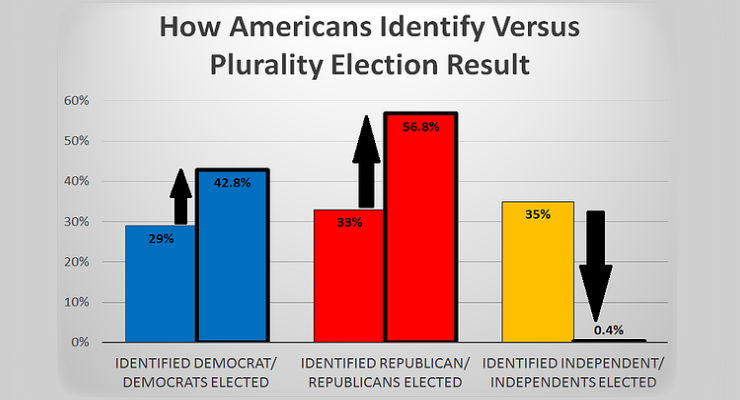
It’s clear who the beneficiaries are here: Republicans and Democrats. If you like those parties, then congratulations, because you’re on an especially long win streak.
But if you’re like the 35% that identify as independents or with a third party, then … it’s not looking so good. There are two independents in the US Congress, Bernie Sanders and Angus King. After this election, there are still only two.
There was, however, an independent governor that won: Bill Walker from Alaska pulled it off. But keep in mind that Walker won under unique circumstances. His Democratic candidate dropped out and joined his campaign as a running mate. It’s not quite the same as going up against both parties.
So how do we keep independents and third parties from getting completely locked out?
One fix would be to use a proportional method (see the Center for Election Science’s glossary). Proportional methods give seats to candidates proportional to the votes they get. If your favorite party got 10% of the votes, they’d also get 10% of the seats, for instance.
But to do a proportional method you need to elect many seats at-large. Staggered elections (See Article 1, Section 3 of the U.S. Constitution) keep this from happening in the Senate. And a federal law (Title 2, U.S.C.§2c) prohibits at-large elections for House seats.
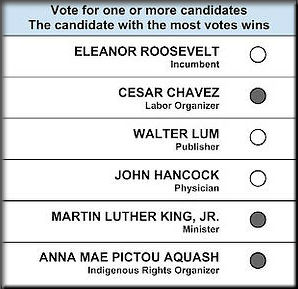
So for the time being we’re stuck using winner-take-all (single-winner elections) for federal seats. With that being the case, we need to move away from our choose-one method, plurality voting. Our choose-one method pushes us to vote against independents, often failing to even explore them. And it’s not because voters aren’t interested—we can tell from the numbers that they are. Voters just don’t want to throw their vote away when they suspect their independent candidate won’t win.
To be able to elect independents, voters need to feel that their vote will still be meaningful. That’s the only way voters will get their version of Bernie Sanders or Angus King for their state. Naturally, we have the answer: approval voting.
Approval voting lets you choose as many candidates as you want. (We are not talking about that ranking method you’re thinking of.) The nice part of being able to choose as many candidates as you want is that you can always choose your favorite, even if you’re not sure your (let’s say) independent candidate can win. You can always choose an additional, more viable candidate simultaneously.
And with other people supporting independents, it gives those that choose not to vote—and those currently not registering to vote at all—a reason to go to the polls. Without approval voting, however, it’s hard to blame those stay-at-home (non)voters given the results we see. Under our choose-one method, independents are practically guaranteed to stay locked out of the picture.
Leave a Reply