As the end of the year approaches, I am finally beginning to confront the death of Fidel Castro, who changed the course of my life forever.
My relationship with him — even as an absence — has always been complex.
When I was little, I remember seeing his photograph, a big bushy beard overpowering the frame. And while we were eating our supper, I would ask my mom innocently, as children often do, “Mom, doesn’t Fidel get his soup noodles stuck all over his beard? And how does he ever get them out after he eats?”
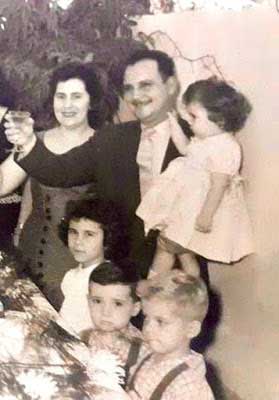
for our future happiness, in Cuba –
Fores Family Album
Maybe that’s what happened to all those around him…
My father fled Cuba because he lacked political freedoms. He believed we had these liberties here in the United States, however, so my brothers, sisters, and I grew up convinced in this country of democratic justice and fair play. This lawyer — my gentle father — could have been imprisoned for years or died for us in Cuba. He suffered greatly trying to escape, just like my mother: as children, we do not remember much. And my parents never talked about it afterward, only to tell us how lucky we were to be living in this land. When my dad chose to come to the United States to ask for political asylum, he knew he wanted us to be able to live and speak freely, and he never doubted that we might not have that.
Just as he could not have foreseen what he saw happening in the land he so loved, his treasured Cuba, I do not think he could have foreseen what is happening now to his adopted country. So I often wonder now what kind of freedoms we have remaining — all these years hence — especially with this new joker who’s befuddled half of the American people….
Every great leader has his good and bad. No one is ever completely good or completely evil, I believe. And so I think Castro suffers from the same. He has done immense good in the world as in Cuba, bringing education to many, as well as healthcare, though many there in the trenches say that is what we see from the outside and it is not so inside.
That may be, but still, his advances in healthcare are great, as well as his stride in education.
But on personal freedoms, well that is another story.
I have no love for the man that was Castro; he made gays suffer immensely. He made prostitutessuffer too. No one could speak their mind and that would curse me to high heaven: can you imagine me not speaking out? He was no friend to religion, and though I have my own very complex view of God, I do believe in a Higher Power, and I don’t know how that would fare in Castro’s Cuba. Though I do hear things have changed in that respect.
So along with the bad, Castro did a lot of good. We need to acknowledge that, no matter our beliefs in his wrongs…
And so many asked me, when Castro died, did you support him?
I stayed quiet most of the time, not saying much, or posting arbitrary things about Castro’s death — not linking to one side or another — because I have such mixed feelings about this man who changed my life so.
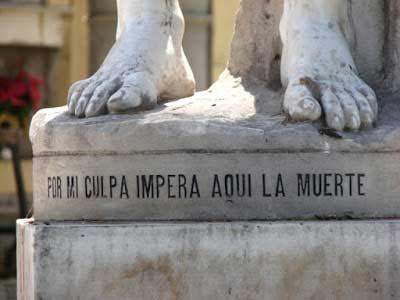
© Ana M. Fores Tamayo
But I do have one reflective loathing, one instinctual animosity: Fidel Castro stole language from me. He stole my land and my language. Thus I belonged to no one and no place. I never really knew my homeland; I never understood my yearnings for that faraway land that was forbidden. I have never seen my Cuba again since that day when I left as a little girl…
And often times I do not feel at ease speaking “my” language.
The language he stole from me.
So I leave you now with my ponderings, on language and on conflict — in both idiomas — because neither one is truly mine…
Conflicto
Atrapada entre dos idiomas
me siento . . . nadie.
 Entiendo que me quiera atraer el romance
de la lengua,
su ritmo escalante,
su sabrosura ardiente.
Las palabras entendidas
y tan poco conocidas
también me seducen,
y el sonido musical me baila,
vuela alto,
se esconde entre los suspiros
y desaires solitarios.
Pero cuando hablo aún no entiendo
el desorden posesivo
de mi otra lengua,
esas palabras que son otras,
no las mías,
que me ahorcan
a través de dos idiomas confundidos.
Siempre sobresale el más sobrio,
el más andante,
el son masculino y agresivo
de ese otro,
el idioma ajeno que hasta poco
creía yo que era el mío.
Pero no lo es,
porque con palabras dulces,
apasionadas e instintivas,
el ritmo de la lenguaes único,
y mi idioma
es la madre en donde
yo nací.
Conflict
An interpretation, not a translation
(because translation is never poetry)
Trapped between two languages
I feel as if I were . . .
no one.
I understand that language may romance me,
its escalating rhythm,
its ardent nectar.
Words that are understood
but so little known
indeed seduce me,
their musical sounds dance with me,
fly on high,
hide among the sighs,
the slights of hand, the solitary snubs.
But when I speak
still I do not understand
the possessive disorder
of my other tongue,
those words that are so different,
not mine,
words that choke me
through two confounded languages.
The more sober one always excels,
that one knight errant,
the masculine aggressive yin
of that other,
the foreign language that until recently
I thought was mine.
But it is not,
because with sweet lyrics,
passionate, instinctual:
the rhythm of the tongue
is peerless,
and my language
is the mother where
I was born.
Leave a Reply