• Skip to primary navigation
  • Skip to main content
  • Skip to primary sidebar

Democracy Chronicles

Towards better democracy everywhere.

  • AMERICAN DEMOCRACY
  • WORLD DEMOCRACY
  • POLITICAL ART
  • more
    • election technology
    • money politics
    • political dissidents
    • THIRD PARTY
      • third party central
      • green party
      • justice party
      • libertarian party
    • voting methods
  • DC INFO
    • author central
    • about
    • advertise with DC
    • contact
    • privacy policy
You are here: Home / Democracy News Headlines / International Democracy / How Game-Theory Can Solve the Moral Free-Rider Problem

How Game-Theory Can Solve the Moral Free-Rider Problem

July 11, 2016 by DC Editors Leave a Comment

FacebookLinkedInPinTweet

Moral Free-Rider Problem

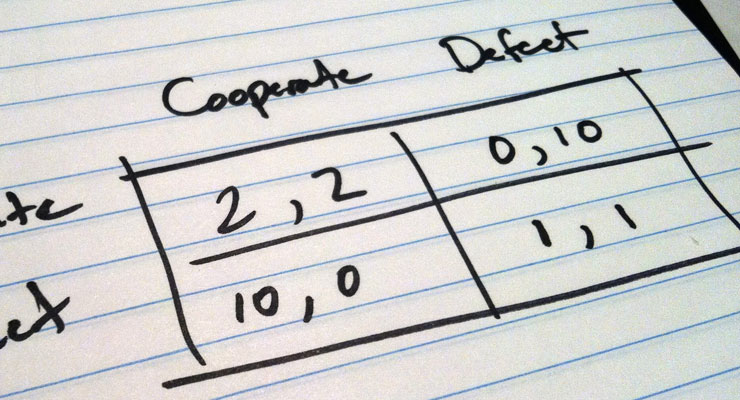
Mathematicians believe they have found a solution to the moral free-rider problem that stymies cooperation

From Science Daily:

A trustful moral judgment system of good or bad is the building block of cooperation in a large group. A rule of thumb for promoting cooperation is to help those who have a good reputation and not those who have a bad reputation. However, making trustful moral judgment requires time, effort and money.

Therefore, this raises a crucial issue — the moral free riders who evade the cost associated with moral judgment (e.g. by not paying taxes for police and court) are better off than those who shoulder the cost. Recent years have seen game theoreticians considering voluntary reactive policing of the moral free riders, which is costly, too, and thus can be exploited by higher order moral free riders. This leads to an infinite regress of opportunities to free ride. The moral free rider problem has remained unsolved.

In this paper, Tatsuya Sasaki, Isamu Okada (Soka University, Tokyo) and Yutaka Nakai (Shibaura Institute of Technology, Saitama) have taken a different approach. The authors present a simple and broadly applicable solution that considers a pre-assessment of the moral free riders. Sasaki and his colleagues devise an extra assessment system that offers an option to contribute to a pool account of the moral cost in advance. This is aimed not only at funding but also at detecting and labelling those who are not willing to pay for justice prior to the social exchange. In social exchanges, the labelled individuals will be refused help. Through game-theory analysis, this study finds that pre-assessment leads to stabilizing a costly moral system and thus cooperation.

This has an important implication to contemporary issues. How good and bad are determined, in fact, varies among individuals with different moral standards. Sasaki and his colleagues show that the pre-assessment could be the common feature for sustaining the moral system, irrespective of its moral code. “Our findings suggest that different individuals may not agree on what justice is but may arrive at a consensus about how justice is maintained. The results of future work that investigates to what extent the pre-assessment affects moral diversity will be fascinating,” says Sasaki.

FacebookLinkedInPinTweet

Filed Under: International Democracy Tagged With: Election Methods, Worldwide

Some highlighted Democracy Chronicles topics

Africa American Corruption American Local Elections American State Elections Asia Capitalism and Big Business Celebrity Politics China Democracy Charity Democracy Protests Democrats Dictatorships Education Election History Election Methods Election Security Election Transparency Europe Internet and Democracy Journalism and Free Speech Middle East Minority Voting Rights Money Politics New York City and State Elections Political Artwork Political Dissidents Political Lobbying Redistricting Republicans Russia Socialism and Labor Social Media and Democracy South America Spying and Privacy Supreme Court Third Party Voter Access Voter ID Voter Registration Voter Suppression Voter Turnout Voting Technology Women Voting Rights Worldwide Worldwide Corruption

About DC Editors

We are your source for news on the all important effort to establish and strengthen democracy across the globe. Our international team with dozens of independent authors are your gateway into the raging struggle for free and fair elections on every continent with a focus on election reform in the United States. See our Facebook Page and also follow us on Twitter @demchron.

Reader Interactions

Leave a Reply Cancel reply

Your email address will not be published. Required fields are marked *

Primary Sidebar

democracy chronicles newsletter

democracy around the web

  • CPJ files declaration in support of detained journalist Mario Guevara 
    Source: Committee to Protect Journalists Published on: 4 months ago
  • “Musk must face lawsuit brought by voters he convinced to sign petition in $1 million-a-day election giveaway, judge says”
    Source: Election Law Blog Published on: 4 months ago
  • “Appeals court throws out massive civil fraud penalty against President Donald Trump”
    Source: Election Law Blog Published on: 4 months ago
  • “Adams Adviser Suspended From Campaign After Giving Cash to Reporter”
    Source: Election Law Blog Published on: 4 months ago
  • “Obama applauds Newsom’s California redistricting plan as ‘responsible’ as Texas GOP pushes new maps”
    Source: Election Law Blog Published on: 4 months ago