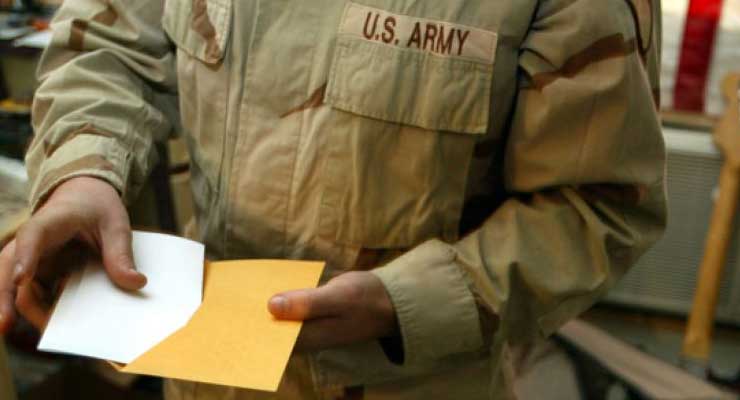
Absentee voting became a national issue following soldier’s need to vote during the Civil War
Post from Dickinson College:
In 1864, the nation was in the midst of civil war and Lincoln was fighting for re-election. With half the nation not voting, this was unlike any other election in American history. And, for the first time, the government had to address the problem of absentee voting for soldiers in the field.
The two main candidates for the election of 1864 were General George McClellan and the current president, Abraham Lincoln. This election was of pivotal importance to the soldiers fighting in the Civil War. A strong commander in chief of the army could be a matter of life or death. Campaigners tried to depict their opponent as a weak military leader as in The Gunboat Canidate comic shown here. Lincoln was aware of how much the right to vote would mean to soldiers, and to his successful candidacy, so he worked hard in the months leading up to the election to insure that soldiers in the field would have their votes count. In previous off-year elections the military proved to be one of Lincoln’s largest demographics. This advantage was not one he was about to let go of. According to the New York Herald, as the winter approached, fighting started to cease and the election “kept our brave army in almost comparative idleness for two weeks.” The nation turned its focus onto the campaign between Lincoln and McClellan. In the days leading up to the election, voting became the most important battle for the Union.
Simply delaying fighting was not enough to ensure that every soldier, many of whom were far from home, would get the opportunity to cast their ballots. At the start of the war absentee voting was unnecessary and almost unheard of. Many worried that such a system would lead to fraud and corruption. Governer Horatio Seymour claimed that absentee voting was unconstitutional, and he tried to prevent its passage into law. However, most politicians knew that they needed the support of soldiers to win. They began to think of ways in which their votes could be counted from the field. According to historian Alexander Keyssar, “for the first time, states were obliged to contend head-on with the issue of absentee voting…nineteen states enacted laws allowing soldiers in the field to vote” (Keyssar, The Right to Vote, 83). Different political groups lobbied for a variety of strategies to ensure that their candidate would receive representation. These strategies included passing out pamphlets and ballots to soldiers, sending representatives to the field to make sure votes were counted, and a system called vote by proxy. Voting by proxy allowed soldiers to mail their ballots home. This was the form of absentee voting that was eventually turned into law in April of 1963.
John Hay was with Lincoln in D.C. on a rainy election day in November. While they waited for updates on the election throughout the day Hay reported that in many cities the voter turnout “can only be accounted for by considering the great influx, since the war, of voting men from the country into the State centers where a great deal of army business is done.” As soldiers returned home to vote absentee ballots were counted across the nation, Lincoln began to see that his victory was inevitable.
About 78% of all the Union soldiers who voted, voted for Lincoln. Most historians credit his victory over McClellan to this. The influence of this election is one that still lives on today. Absentee voting is legal across the country and is an unquestioned part of voting rights in America.
WASHINGTON, Nov. 24, 2015 /PRNewswire-USNewswire/ — Following is the daily “Profile America” feature from the U.S. Census Bureau: ABSENTEE VOTING Profile America — Tuesday, November 24th. This month marks the 151st anniversary of absentee ballot voting in the U.S. This measure was introduced during the Civil War to permit Union army soldiers in the field to…
Leave a Reply