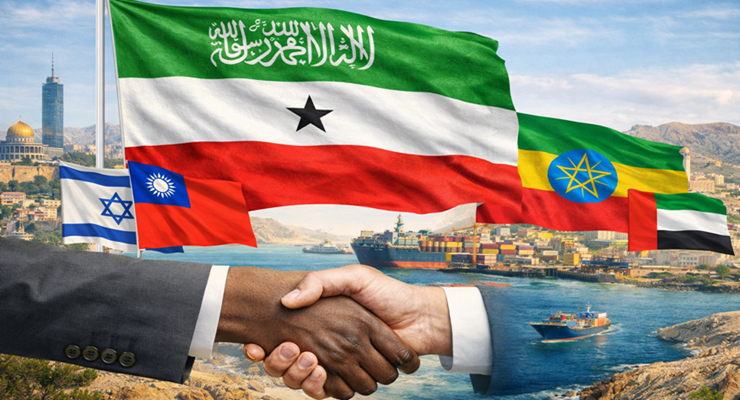
The headline: “President of Somaliland visits Israel“ isn’t at the top of the media’s listicles, but it is an important piece of the bigger picture.
Back up, let me explain: what we think of as “Somalia” is actually two countries, divided like North and South Korea, oddly mimicking that split dynamic where one country is an utter disaster (North Korea/Somalia) and the other is a prospering, democratic ally of the West (South Korea, Somaliland). That’s a good way of framing it, and it is an object lesson in “systems matter” – democracy matters.
Except… in the Horn of Africa’s case, the Somaliland good guys are barely recognized by the international community, unlike South Korea.
Non-recognition is disastrous, a huge tax. It impacts every aspect of a country’s fortunes: the UN, corporate insurance, trading, contract rights, flight patterns, currency, passports, and ease of travel. And yet, even without broad recognition, Somaliland is democratic and has somehow flourished for thirty years.
“Somaliland” was a British colony, “Somalia” an Italian one until the independence of both in 1960. Somaliland was immediately monstered, bombed, and colonized by Somalia for three decades.
In 1991, Somaliland gained control over its frontiers after having the stuffing beaten out of them, to the tune of hundreds of thousands of dead and a ruined, bombed capital city. The Issak Genocide by Somali forces bombing their Somaliland neighbors is, unfortunately, rarely remembered as a major crime of the last century.
In an impressive middle finger, the Somalilanders propped up a Somali Russian MiG jet they shot down while it was bombing them on a plinth in their capital, Hargeisa, in a total “boss move.”
After three decades of de facto independence, in recent years Somaliland has established diplomatic relations with Taiwan and earlier this year with Israel. They’re playing footsie with their huge Ethiopian neighbor, and they’re “in tight” with the Emirates, a nation increasingly shaping that part of the world. Hopefully, imminent American recognition will cascade into other countries raising Somaliland up to deal on equal terms with the rest of the civilized world.
There are two sides to our global reality now: like the Cold War good guys and bad guys.
There’s Russia, China, Iran, North Korea, Somalia, and Hamas/”Palestine,” in what historian Niall Ferguson calls the “axis of ill will,” versus the forces of democracy whose trade, gentle commerce, and classical liberal enlightenment values enhance human flourishing. On that side lie the United States, NATO, Israel, and the “first island chain” in East Asia like Taiwan. This is the collective “West,” which Somaliland has joined, to the anger of their Third World failed state enemies.
In the shadow of Israel and Somaliland establishing full diplomatic relations, Somaliland’s President Abdulrahman Abdullahi had this recent flashy official state visit to Israel.
This new alliance is deeply inspiring because, despite being different races, speaking different languages, and crucially Somaliland being Muslim, reasonable people on both sides could come together and, outraging and shocking many, form a real friendship.
Further, in making friends with Israel, Somaliland has really irritated the Arab League, the entire Islamosphere, and the UN. For a poor, Islamic country to conduct such a wild maneuver as an alliance with the Zionists is a big bet – a sincere vote for civilization that will pay dividends.
It’s worth noting also that, rare for Africa, Somaliland is not a vassal or tributary state of the People’s Republic of China.
Somaliland is poor but stable. They seem to make a lot of pretty edgy but profitable decisions. Consider their currency: a challenge because no international banking organizations recognize the country, so their cash is counted in brick-sized, rubber band-tied stacks. Not good, so the Somalilanders skipped ahead to a smart, internet-based fintech solution. It is now a fintech hub of Africa.
Further, realizing the value of port infrastructure, they enticed the UAE – a preeminent regional player – to build a port in Berbera and a cement factory, both of which are doing well.
Coincidentally, all this is at the Bab al-Mandeb, the Red Sea entrance where the hooligan Houthis of Yemen have been increasing the cost of your Amazon purchases and interrupting freedom of navigation for several years by doing classic Houthi stunts like blowing up other people’s ships. For Allah, you see.
Like Singapore, Somaliland is leveraging its position at one of the chokepoints of world trade. Nearby Djibouti has done this, but Djibouti is an unreliable ally, a closed almost parody-level kleptocracy. Obviously, Red Sea commerce is even more important given all the celebrations and excitement in the Persian Gulf these days with the Iranians.
Meanwhile, failed state Somalia desperately appeals, on dubious grounds, to the Third World, their new overlords Turkey and the Saudis from “Villa Mogadishu” – the only land they really govern around the capital, or presidential compound sometimes.
The rest of Somalia is two breakaway states, Puntland and Jubaland, with the rest being a Mad Max post-apocalyptic chaos of starving people and wild jihadis, home of Islamic terrorist Al Shabab (“The kids” – no kidding). Quietly, US forces routinely hammer Islamic terrorists in the mountains.
Though, on balance, Somalia recently signed an alliance with Myanmar, an equally dysfunctional failed dystopic ruin on the other side of the Indian Ocean. Embarrassing.
If you look at Somaliland vs. Somalia, think North and South Korea. Somaliland (the good one) is desperate for American and thus wider international recognition. Their new friendship with Israel is not just profitable in itself (medicine, water issues which bedevil hot, dry Somaliland), but even if it doesn’t move the needle to wider recognition, it is a plus.
If it does, and Somaliland’s independence is recognized more widely with international finance, diaspora investment, and even things you never think of like ICAO (world airline association), there’s no reason why Somaliland can’t be the richest country in Africa a decade hence.
They have the democracy, property rights, and sound judgment necessary to let humans flourish and prosper. The people there have, by ballot, rejected crazy and impoverishing “Third Worldism,” the Russian menace, socialism, and political Islamism. And that is… alright.
Leave a Reply