We have our presidential election data! We’re going to be publishing multiple articles because there is just SO MUCH data.
Here’s the gist of what we’ve done. Our analysis team used a technique called Mr. P that involves reweighting the data according to demographics without overfitting the model. The sample size for our short list of four candidates was over 1,000. Our sampling was conducted by GfK and used a panel technique so that respondents were representative of the national population. All respondents were registered to vote.
Once we’re done with all our analysis, we’ll be releasing the raw data itself in a way that preserves the anonymity of respondents. But since we have so much data, we’ll likely be going for a while before we release it.
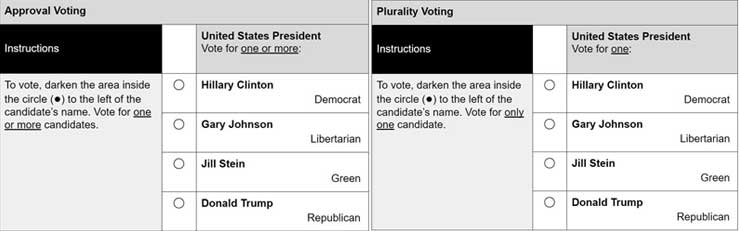
For this first article, we’ll keep it simple: plurality voting versus approval voting with just four candidates. We’re looking at the two major-party candidates along with the leading alternative parties, Libertarian and Green. Later, we’ll have a 9-way analyze that includes candidates Bernie Sanders, Michael Bloomberg, and others. That sample by GfK is from another 1,000 respondents.
For newcomers, plurality voting is the system we have now, which restricts you to selecting just one candidate. We used the actual plurality results here. Approval voting is a voting system that allows you to choose as many candidates as you want. With both voting methods, the candidate with the most votes wins. And with the approval voting method, totals counts can add up to over 100% since each voter can select multiple candidates.
As we can see right away, the winner didn’t change. Hillary Clinton still edges out Donald Trump in a four-way race with a national popular vote, whether the method is approval voting or plurality voting. It’s natural that switching the voting method doesn’t change the winner in every election, and in this case it doesn’t.
That said, some candidates’ support have changed significantly. Let’s start with Gary Johnson. Under plurality voting, Johnson got 3% of the vote. But under approval voting, Johnson got seven times that at 21%. Seven times!
Jill Stein saw a similar bump. While her overall support was less than Johnson, her support relative to plurality increased 12-fold. She went from 1% to 12%.
What’s more impressive is that a Gallup poll from earlier this year indicated that only about a third of US adults even knew who Johnson and Stein were. That’s in light of them both running in the 2012 election as well. One can argue that their lack of popularity and visibility was because our plurality voting system treated them as though no one supported them. That inaccurate reflection from plurality voting surely helped to keep these third-party candidates out of the presidential debates as well.
Why is it that these third-party candidates get a bump under approval voting? That’s because with approval voting, you don’t have to fear “wasting” your vote on a third-party candidate. You can always simultaneously hedge your bets with a major-party candidate while also selecting any other candidate you’d like to support. That’s an option that simply doesn’t exist under plurality voting or even instant runoff voting (ranked-choice voting). You can see from our raw data in the figure above that every person approved their honest favorite candidate under approval voting. That is, no one “betrayed” their favorite.
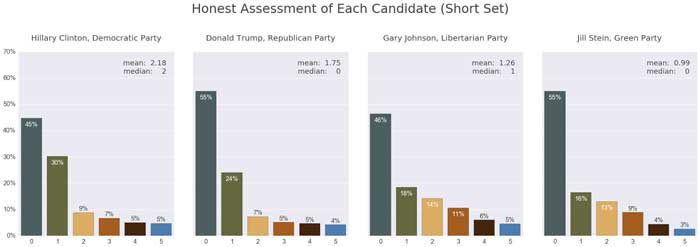
Oh, and we know how people honestly felt about the candidates. We asked them to indicate how much they would like a candidate elected regardless of their likelihood of winning. They responded on a 0-5 scale with five indicating that they strongly wanted that person elected.
One criticism of approval voting is that many voters “bullet vote”. That is, they vote for one person when they have the option to vote for more. And for some people, only voting for one person makes the most sense. But it only takes a portion of people choosing multiple candidates to make an impact.
Consider the number of people who chose more than one candidate. Most didn’t. But enough did that it made a huge difference to candidates outside the two major parties. There’s also a tendency to approve more candidates on average when there are more candidate options. Here, our modeled data has each voter approving 1.3 candidates, on average.
A voting method can change a number of outcomes. It can change who wins, who votes, candidates’ support, and who runs. With this election, what we saw was a big difference in how candidate support was reflected. Under a limited plurality voting ballot, however, we saw very little support for alternative candidates.
Our polling results revealed that, with the approval voting method, third-party candidates would have received a LOT more support than what we saw in the actual election—which used the plurality voting method. Stay tuned for more analysis looking at other voting methods as well as what the election would have looked like in a nine-candidate race under different voting methods. We’ll also have the opportunity to look at state-by-state results.
Leave a Reply