
• Skip to primary navigation
  • Skip to main content
  • Skip to primary sidebar

Democracy Chronicles

Towards better democracy everywhere.

  • AMERICAN DEMOCRACY
  • WORLD DEMOCRACY
  • POLITICAL ART
  • more
    • election technology
    • money politics
    • political dissidents
    • THIRD PARTY
      • third party central
      • green party
      • justice party
      • libertarian party
    • voting methods
  • DC INFO
    • author central
    • about
    • advertise with DC
    • contact
    • privacy policy
Home | DC AUTHORS | Approval Voting at the Republican Liberty Caucus Straw Poll

Approval Voting at the Republican Liberty Caucus Straw Poll

October 30, 2015 by Aaron Hamlin Leave a Comment

FacebookLinkedInPinTweet

Republican Liberty Caucus Straw Poll

The Center for Election Science (CES) recently handled the Republican Liberty Caucus straw poll, where Rand Paul topped Ted Cruz for first. And once again, approval voting demonstrated its superiority over the ubiquitous choose-one plurality voting.

Approval voting lets voters choose as many candidates as they like, avoiding the typical pitfalls of our choose-one plurality voting. The fact that the Republican Liberty Caucus chose to release the approval voting results as the main poll results is telling.

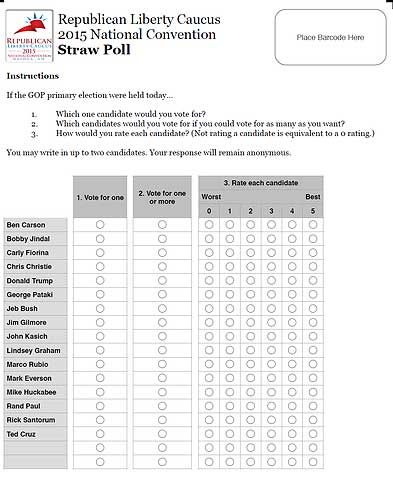
Here’s a look at what voters had in front of them for the poll:
Republican Liberty Caucus Straw Poll

All 779 voters were asked to vote three different ways: (1) The standard choose-one plurality method, which causes vote splitting; (2) approval voting, which lets voters pick as many candidates as they want; and (3) score voting, which lets voters score candidates on a scale.

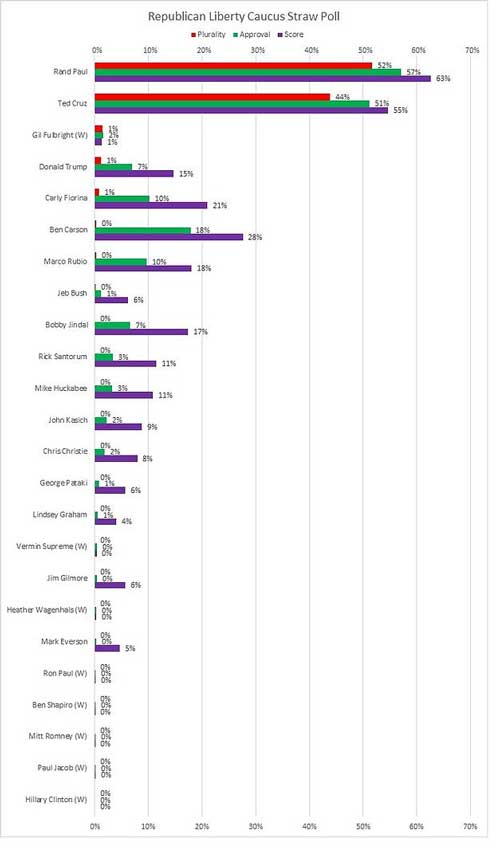
Which method voters used made a big difference. Just have a look (score voting is shown here as a percentage of maximum score for comparison purposes; “W” indicates a write-in):
Republican Liberty Caucus Straw Poll

Paul and Cruz happened to get proportionately similar results in both plurality and approval voting, though that’s not always the case. What’s striking, however, is the difference among the other candidates. Without approval or score voting, the remaining candidates would be indistinguishable. With these better voting methods, however, you see multiple candidates stand out.

Carson, Fiorina, and Rubio, all get roughly 10% approval or above while Jindal and Trump begin to show their existence with the more nuanced score voting. Under choose-one plurality, however, they’re indistinguishable from the rest of the pack at 1% or less.

So why does traditional choose-one plurality give artificially low results while approval voting gives a clearer picture? CES chair Dr. Andrew Jennings summarized the answer to the Washington Examiner: “[Approval voting] prevents spoilers and lets all candidates see their true level of support by preventing the vote from being split in a crowded Republican field.”

Many candidates otherwise get artificially low support because our choose-one plurality ballot doesn’t let voters provide any information. It’s not until we remove the choose-one restriction that they’re actually able to have a say about the other candidates.

Now here’s the obvious question. If using approval voting fixes straw polls, then why do parties continue using a choose-one plurality method for their primaries?

[Link to ballot data] [Video for checking ballot data] [Check your 3-digit ballot]

Ballots choosing a candidate under plurality were also given approval for that candidate for internal consistency.

FacebookLinkedInPinTweet

Filed Under: DC Authors Tagged With: Election Methods, Polling, Republicans

Some highlighted Democracy Chronicles topics

Africa American Corruption American Local Elections American State Elections Asia Capitalism and Big Business Celebrity Politics China Democracy Charity Democracy Protests Democrats Dictatorships Education Election History Election Methods Election Security Election Transparency Europe Internet and Democracy Journalism and Free Speech Middle East Minority Voting Rights Money Politics New York City and State Elections Political Artwork Political Dissidents Political Lobbying Redistricting Republicans Russia Socialism and Labor Social Media and Democracy South America Spying and Privacy Supreme Court Third Party Voter Access Voter ID Voter Registration Voter Suppression Voter Turnout Voting Technology Women Voting Rights Worldwide Worldwide Corruption

About Aaron Hamlin

Aaron Hamlin is the executive director and co-founder of the Center for Election Science. Working from Ohio, he's been consulted on voting procedures for small to large organizations and publicly elected officials in several states. He's been published in numerous outlets and has been invited as an expert speaker at conferences across the country. Aaron is also a licensed attorney with additional graduate degrees from Indiana University and Miami University.

Reader Interactions

Leave a Reply Cancel reply

Your email address will not be published. Required fields are marked *

Primary Sidebar

democracy chronicles newsletter

democracy around the web

  • CPJ files declaration in support of detained journalist Mario Guevara 
    Source: Committee to Protect Journalists Published on: 8 months ago
  • “Musk must face lawsuit brought by voters he convinced to sign petition in $1 million-a-day election giveaway, judge says”
    Source: Election Law Blog Published on: 8 months ago
  • “Appeals court throws out massive civil fraud penalty against President Donald Trump”
    Source: Election Law Blog Published on: 8 months ago
  • “Adams Adviser Suspended From Campaign After Giving Cash to Reporter”
    Source: Election Law Blog Published on: 8 months ago
  • “Obama applauds Newsom’s California redistricting plan as ‘responsible’ as Texas GOP pushes new maps”
    Source: Election Law Blog Published on: 8 months ago