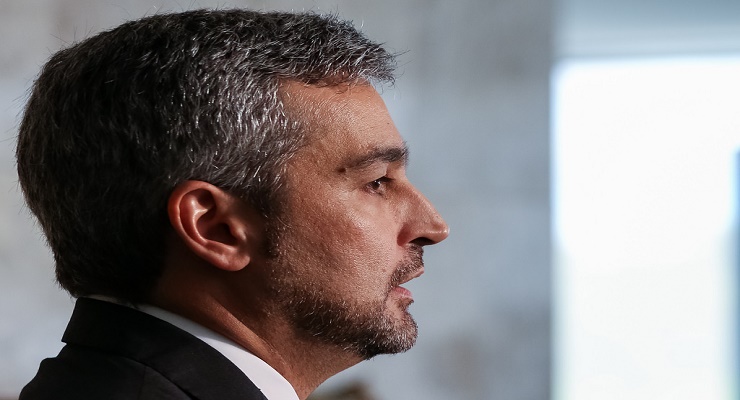
Last Wednesday, August 15, Mario Abdo Benítez (Marito, as his followers call him, to distinguish him from his father, who was dictator Alfredo Stroessner’s private secretary) took office as the ninth president of Paraguay since the return to democratic rule in 1989. He was elected in the general elections last April, when he defeated Liberal Efraín Alegre, by a slim margin of 3.7%.
The Paraguayan political regime is presidential, with a five-year term and no reelection. The electoral system does not include runoff elections, the Congress is bicameral, and its election is concurrent with that of the president.
Democracy in this “island surrounded by land,” as Paraguayan writer Augusto Roa Bastos defined his country, is almost 30 years old. In 2018 the seventh general election was held for national authorities. Since the fall of the Stroessner dictatorship all presidents have held office for just one term, thus breaking with a long history of authoritarian government, such as the one headed up by General Stroessner himself.
Abdo Benítez (46 years old) is the leader of a renovationist sector of the Asociación Nacional Republicana (ANR), better known as the Partido Colorado. The party has maintained its hegemonic domination of Paraguayan for more than 70 years, except during the presidential term of 2008-2013, under the presidencies of Fernando Lugo (Frente Guasú, center-left) and Federico Franco (PLRA).
According to the Democracy Index of the Economist Intelligence Unit, associated with the British publication The Economist, Paraguay scores 6.31 points out of 10, placing it in the group of flawed democracies.
Paraguay has shown slight progress in recent years in its support for democracy; according to Latinobarómetro 2017, from 2016 to 2017 Paraguay saw a 4-point increase in support for democracy, reaching 59% (6 points above the regional average of 53%). And while 76% of the population states that democracy is the best form of government, on a scale of 1 to 10, where 10 describes the perception that one is living under a full democratic regime, the score has been 3, compared to a regional average of 5.4.
Tailwind and challenges
Abdo Benítez’s term is getting off to a start with winds in his favor, but also plagued by obstacles and challenges.
The tailwind is in the economy. This small country with a population of seven million, and the world’s fourth-leading exporter of soybean, has shown solid growth, greater than 5% on average for the last five years – far above the regional average – yet highly dependent on natural resources. Inflation is manageable (4.2% annually), and the fiscal deficit and public debt are low (1.5% and 26% respectively). Fitch’s rating agency recommended that the new president maintain a prudent economic policy, improve governance, and strengthen transparency.
This high economic growth coexists with high poverty (26.4%, more than half of whom live in rural areas) high informality (40%), precarious labor conditions, widespread corruption (ranks 135th on Transparency International’s Global Index), low tax burden (13% of GDP), and marked institutional weakness, above all as regards the lack of independence of the judicial branch.
To respond to these challenges, Abdo Benítez promised to focus his priorities in four main areas: (1) maintain macroeconomic stability, increase the rate of growth, and generate quality employment; (2) improve access to and the quality of education in a country in which 60% of the population is under 30, only 4 in 10 finish the basic cycle, and only 1 in 100 completes a university education; (3) respect the institutional framework and the separation of powers, especially the independence of the judiciary, putting an end to the existence of “a friendly justice system,” so as to tackle head-on corruption and impunity – which he has called the “cancer to beat”; and (4) putting in place effective social policies to promote inclusion and reduce the very heavy social debt.
Yet implementing this ambitious agenda will not be easy for him: without a majority in the legislature and with a Partido Colorado that is divided among his sector, another independent sector, and the third under the influence of former President Horacio Cartes (who according to all indications will be waging a tough opposition), governability is not assured. In effect, of the 45 senators, the Colorados have 17, eight of whom answer to the line of President Abdo Benítez, two of whom are “independent,” and six of whom are faithful to the leadership of former President Cartes. The Liberals have 13 seats, the Frente Guasú has six, the Patria Querida party has three senators, the Partido Democrático Progresista has two, the emerging Partido Hagamos has two, and, finally, the Cruzada Nacional movement has one seat in the Senate. In the Chamber of Deputies (lower house), of a total of 80 seats the Colorados have 42, but they are also divided into several camps.
As we see, the new president’s lack of a political support base, and his minority in the legislature, which is highly fragmented, will force him to negotiate with all the political sectors, both in and out of the Colorado party. To that we should add the tougher stance being adopted by the population (especially urban middle classes and youth) towards corruption, a clientelist political system, and an inefficient state.
Abdo Benítez is proposing a radical change in Paraguay, including a possible reform of the Constitution. His promises are being made at a time when Paraguay is experiencing growing citizen mobilization. If he is to succeed, he must listen to and quickly respond to the cries of a society that is sick and tired of corruption and its leaders’ mistakes. Public opinion and the analysts are divided between the skeptics – who are of the opinion that Abdo Benitez will merely represent continuity of the conservatism of the Colorado party, and those who believe in his promises of change. His inaugural address was solid and well-received. Now it’s time to govern and to follow through on the promises.
Leave a Reply