From Science Daily:
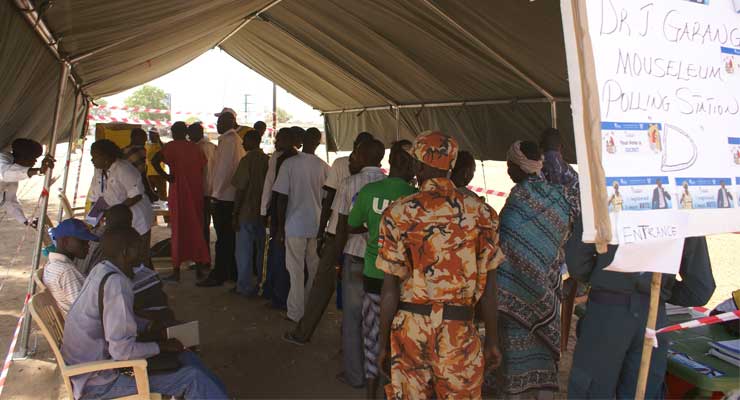
Donald Trump’s surprising election as president of the United States was viewed by some people as evidence that electoral polling no longer works, but researchers report they have developed models using global polling data that can correctly predict up to 90 percent of election outcomes around the world.
The study, published Feb. 2 in the journal Science, focused on executive elections in which voters cast ballots directly for the person who will hold executive office, rather than having that leader elected by parliament. The researchers say it offers strong evidence that polling data, used correctly, is the best predictor of election outcomes.
“This study suggests polling data can be utilized not just in the United States but globally to predict election outcomes,” said political scientist Ryan Kennedy of the University of Houston’s Center for International and Comparative Studies and lead author on a paper published Feb. 2 in the journal Science. “It would be a mistake to abandon the enterprise. The future really is in trying to make better quantitative predictions.”
Researchers tested the model as part of a project sponsored by the Intelligence Advanced Research Projects Activity, part of the Office of the Director of National Intelligence, which supports research with applications for the intelligence community. They submitted forecasts two weeks prior to elections in Latin America in 2013 and 2014 and correctly forecast the winners in 10 out of 11 elections, or 90.9 percent of the time.
A second test, involving live predictions for all global direct executive elections starting in mid-2013, had a success rate of 80.5 percent.
The model was developed using an election dataset covering more than 500 elections in 86 countries, along with a separate dataset that incorporated polling data from 146 elections. In addition to Kennedy, authors on the paper were Stefan Wojcik and David Lazer, both affiliated with the Lazer Lab at Northeastern University and the Institute for Quantitative Social Science at Harvard University.
They discovered that economic growth had little impact on election outcomes. “Although there is a long literature on the effect of economic growth in elections, we found little to suggest a global rule, with only minor impacts for inflation observed,” they wrote. “Less democratic institutions, unsurprisingly, tended to favor the incumbent party.”
Kennedy said open democratic elections and whether one candidate was an incumbent improved the likelihood of accurate predictions. “The person who holds the seat is able to use their power and name recognition to win subsequent elections.”
But, he said the most valuable predictor proved to be polling results, something that proved true across the globe.
“People normally wouldn’t find this surprising. but given the recent (U.S. presidential) election, now it does seem surprising,” he said. “Where there was a poll, it was reasonably good at predicting outcomes, even in places you wouldn’t think you’d be able to have accurate polling.”
Polling techniques used for decades in the United States also are successful in countries without a history of effective polling, Kennedy said.
The researchers say their findings are especially salient in light of Trump’s victory, which prompted predictions of the death of data and polling.
Not so, said Kennedy, noting that he and his collaborators predicted an 84 percent chance of a Clinton victory. “That meant a 16 percent chance of a Trump victory,” he said. “Unlikely but still possible.
“We often think anything over 50 percent means absolutely an outcome is going to happen. That’s not necessarily the case.”
Story Source:
Materials provided by University of Houston. Original written by Jeannie Kever. Note: Content may be edited for style and length.
Journal Reference:
Ryan Kennedy, Stefan Wojcik, David Lazer. Improving election prediction internationally. Science, 2017; 355 (6324): 515 DOI: 10.1126/science.aal2887
Cite This Page:
University of Houston. “Polling is still best predictor of election outcomes, study suggests: Research found use of polling data effective even in developing countries.” ScienceDaily. ScienceDaily, 2 February 2017.
Leave a Reply