Minority Groups Struggle to Find Voice in Changing Myanmar’s Democracy as Violence Spikes | Democracy, elections, and voting at Democracy Chronicles
by Yong H Wang
Hopes for a more stable and democratic Myanmar are burning bright, especially after the election earlier this year, which finally ushered in members of the National League for Democracy (NLD) into the government. This is a great step forward that has inched Myanmar closer to democracy. However, something is lost, or rather softened, in the fanfare of international optimism and shouts for the removal of sanctions against Myanmar, and that is the plight of the ethnic minority groups and the question of their role in the national shift towards stabilization and democracy.
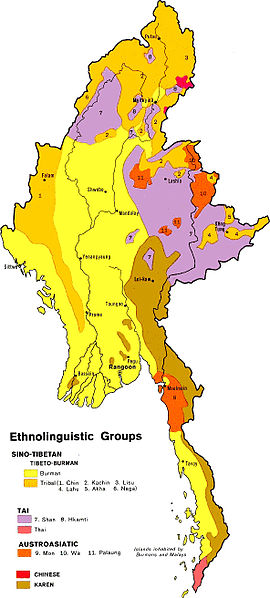
The majority ethnic group, the Burman, comprise 68% of the population, but the remaining 32% belong to approximately 131 distinct groups. There is amazing diversity in Myanmar, and for a time that almost led to succession. Ethnic dissent and opposition to the junta have been an ongoing issue, although it is much resolved now. For decades the Shan, Karen and other groups would launch armed attacks against the army. The reason behind this was the political marginalization and economic inequality that ethnic groups live with.
Going forward, in order for any lasting, stability and peace to be held, ethnic militias cannot continue as they do, just as the army cannot keep on with their violence and human rights violations. A pillar of democracy is checks and balances and the curtailing of military power. Whereas in an authoritarian regime, the military has unchecked authority and force is one of the principle character of the state.
Some groups have periodically made cease-fire pacts with the government; these include large groups like the Kachin Defense Army and Kayan National Guard and small groups such as the Democratic Karen Buddhist Army. Groups like the Kachin Defense Army and the Kayan National Guard promise to stop attacks against the national army and not support the groups that do. Meanwhile groups like the Democratic Karen Buddhist Army have gone a step further by turning in their armaments.
More recently, earlier this year, the largest last remaining resistance army, the Karen National Union, was reported to have signed a cease-fire agreement with the national army. However that’s not where the story ends; rather, this is just one of several findings of Myanmar’s rocky transition toward democracy and how ethnic minorities play a part. Approximately four weeks after the news of the cease-fire agreement was released around the world, leaders of the Karen National Union came out denying that a cease-fire agreement had been finalized.
The reluctance to sign a cease-fire agreement is somewhat understandable when one looks at it from the perspective of the Karen, who have been fighting against the national army the longest. This is so because ethnic groups are still rather distrustful of the national government, the recently exposed pogrom of the Rohingyas, one of the longest and most oppressed ethnic groups in Myanmar, supports that distrust.
All in all, Myanmar is making some of the right choices as they advance towards democracy, such as allowing the NLD to join in the ranks of power and reaching out to guerrilla armies to end fighting, but it also has a long way to go to assure those historically and continuously marginalized, exploited and harmed that democracy will include them and improve their lives. They must resolve the deeper issues of culture and history if Myanmar wants to be sure they are building a republic that lasts. Though the path is long and difficult, it should be pressed to stay on and redevelop itself as a democratic nation after decades of authoritarian and colonial rule.
Sources:
The New York Times, July 12, 2012 – nytimes.com
The New York Times, February 3, 2012 – nytimes.com
The New York Times, January 12, 2012 – nytimes.com
The New York Times, April 1, 2012 – nytimes.com
Pedersen, Morten B. “Burma’s Ethnic Minorities.” Critical Asian Studies 40.1 (2008): 45-66. Political Science Complete. Web. 29 July 2012.
Time Magazine, January 30, 2009 – time.com
BBC News, November 5, 2010 – bbc.co.uk
Leave a Reply