• Skip to primary navigation
  • Skip to main content
  • Skip to primary sidebar

Democracy Chronicles

Towards better democracy everywhere.

  • AMERICAN DEMOCRACY
  • WORLD DEMOCRACY
  • POLITICAL ART
  • more
    • election technology
    • money politics
    • political dissidents
    • THIRD PARTY
      • third party central
      • green party
      • justice party
      • libertarian party
    • voting methods
  • DC INFO
    • author central
    • about
    • advertise with DC
    • contact
    • privacy policy
Home | DC AUTHORS | Government Emails: See No Evil, Hear No Evil, Save No Evil

Government Emails: See No Evil, Hear No Evil, Save No Evil

October 16, 2014 by Stephanie Singer Leave a Comment

FacebookLinkedInPinTweet

Government Email Secrecy and Transparency

by the City Commissioner of Philadelphia, Stephanie Singer

I started using email in 1985, the same year I first had a computer on my desk. I was a graduate student in the Computer Science Department at Stanford. That year, after a brief period of addiction to a computer game called “Hack” — whose visual world was built entirely out of punctuation, like an emoticon on steroids — I settled down to work, and soon began to rely on my email history to organize and remember my activities and commitments. Am I meeting my professor at 2:00, or is it 2:30? Didn’t I answer that question for you last month? Email had the answers.

By 2010, email was a standard tool at the small business where I worked. I held myself accountable by flagging messages that needed a response. And my boss used email to hold all of us accountable — she didn’t have to wonder whose court the ball was in, because the evidence was right there in the email. Email also provided documentation that could be useful in case of a legal dispute.
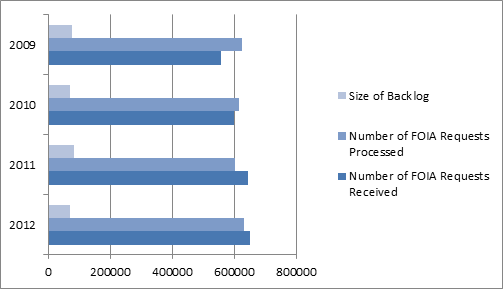
FOIA requests
At the federal level: Freedom of Information Act requests and backlog.

As head of IT in that company, I helped set up the email storage system. How many years of emails should an employee have immediate access to? After three years, can we delete the attachments (to save space)? Which of the many email archiving software programs fits our needs best? Should we archive all messages for seven years, or just five?

When I took office as City Commissioner in 2012, my government emails were archived automatically, as I expected. But since 2013 I have been unable to retrieve emails more than 50 days old. Emails deleted as a matter of course. Other policies make it impossible to set up an automatic archive. Even as a City Commissioner with a background in IT working in concert with the City’s IT staff, I can’t find a way to save my emails in bulk, not to mention automatically.

So I do what many City employees do: I forward my outgoing email to a personal email account and try to remember to copy my outgoing emails to that account as well. If an email is particularly important, I print it out and put it in an old-fashioned file cabinet. And I develop new ways to hold myself accountable.

But how will my boss, the people of Philadelphia, hold me and my colleagues accountable while the City erases our email trail? How many important right-to-know requests yield nothing because the emails have disappeared? How many ethics or fraud investigations are stymied by this see-no-evil, hear-no-evil, save-no-evil policy?

The City of Philadelphia should immediately change the 50-day deletion period to at least a year, as well as archiving all emails for at least three years.


Please remember to vote on November 4!

FacebookLinkedInPinTweet

Filed Under: DC Authors Tagged With: American Local Elections, Election Transparency

Some highlighted Democracy Chronicles topics

Africa American Corruption American Local Elections American State Elections Asia Capitalism and Big Business Celebrity Politics China Democracy Charity Democracy Protests Democrats Dictatorships Education Election History Election Methods Election Security Election Transparency Europe Internet and Democracy Journalism and Free Speech Middle East Minority Voting Rights Money Politics New York City and State Elections Political Artwork Political Dissidents Political Lobbying Redistricting Republicans Russia Socialism and Labor Social Media and Democracy South America Spying and Privacy Supreme Court Third Party Voter Access Voter ID Voter Registration Voter Suppression Voter Turnout Voting Technology Women Voting Rights Worldwide Worldwide Corruption

About Stephanie Singer

Stephanie Singer is a former City Commissioner of Philadelphia and worked to modernize the office, introducing improved hiring practices, encouraging digital distribution of public elections data, and promoting free and fair elections.

Reader Interactions

Leave a Reply Cancel reply

Your email address will not be published. Required fields are marked *

Primary Sidebar

democracy chronicles newsletter

democracy around the web

  • CPJ files declaration in support of detained journalist Mario Guevara 
    Source: Committee to Protect Journalists Published on: 9 months ago
  • “Musk must face lawsuit brought by voters he convinced to sign petition in $1 million-a-day election giveaway, judge says”
    Source: Election Law Blog Published on: 9 months ago
  • “Appeals court throws out massive civil fraud penalty against President Donald Trump”
    Source: Election Law Blog Published on: 9 months ago
  • “Adams Adviser Suspended From Campaign After Giving Cash to Reporter”
    Source: Election Law Blog Published on: 9 months ago
  • “Obama applauds Newsom’s California redistricting plan as ‘responsible’ as Texas GOP pushes new maps”
    Source: Election Law Blog Published on: 9 months ago