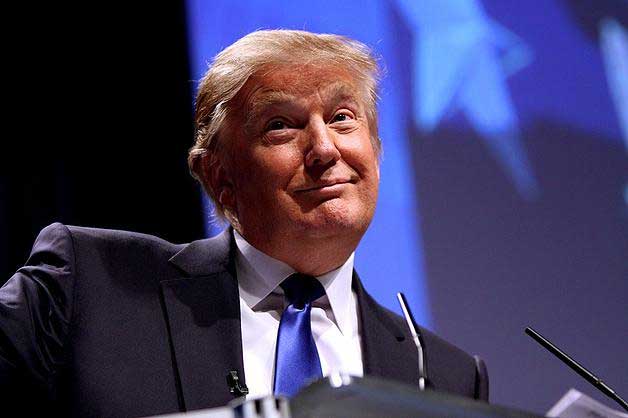
Trump Raises His Hand
The first debate moderator asked for any Republican candidate to raise his hand if running a third-party/independent campaign was not out of the question.
Trump raised his hand.
The boos in the Fox studio were unmistakable. Trump later insinuated the threat to run independent was just a leverage tool to have the Republican establishment treat him more fairly. But that didn’t stop the boos from continuing after the debate.
“You’ve got to keep him in the tent,” former Republican Congressman Thomas Davis told The Times. “He just wreaks havoc, and every vote he takes comes out of our hide.”
Our Terrible Choose-One Voting Method
People worry that our choose-one voting method will cause the vote to divide between Trump and a Republican candidate, leaving a Democrat to win. And they’re right to worry. Our voting method is terrible about doing things like that.
Vote splitting or—more specifically—the spoiler effect is already in the minds of elected politicians. This is a big reason why ballot access laws are so absurd in the US. Keep the race to two candidates and there’s no vote splitting. Ballot access expert Richard Wingertold CNN that Trump would need over a million signatures to get on all fifty state ballots if he went outside the Republican party.
Trump will need this crazy number of signatures because in practice you need double the actual requirement. Doubling the requirement is the only way to overcome the hostile legal challenges major parties use to monopolize the ballot. In that same CNN article, former Libertarian nominee Gary Johnson said it would cost $8 million just to get on all fifty state ballots. As you might guess, Democrats and Republicans have written the laws so it’s quite simple to get on the ballot themselves.
And then there are the sore loser laws. Run in a major party primary and rule out running as an independent or third party. Fortunately for Trump, however, Winger found that nearly every state’s sore loser laws do not apply to presidential elections. And in many cases, there’s a workaround for the exceptions.
But why insist on the most undemocratic response that Trump—or anyone else for that matter—not run? Isn’t there another way?
Approval Voting Solves It
There is. Abandon our current choose-one voting method—the worst voting method there is. If the problem comes from being limited to choose one candidate, then instead let voters pick as many candidates as they want. This is called approval voting.
One might ask if approval voting could be done within our electoral college system. Amazingly, the answer is yes.
The current approach to sidestepping the electoral college is to use an interstate compact, which is just an agreement between states. And yes, it’s very likely to be constitutional. This interstate agreement has states assign their electoral votes to whichever candidate wins the national popular vote, regardless of the winner for their particular state. This compact would become active as soon as the states signing on have electoral votes totalling greater than half of all 50 states’ electoral votes. And we’re two-thirds of the way there.
But sidestepping the electoral college isn’t cause to celebrate too hard. At the end of it all, you’re still using our awful choose-one voting method. So you’d need to insert a new voting method into the national popular vote plan. And in order to do that, you need a voting method that can take its vote totals from states and local precincts and then add those up to the national totals.
This may sound like a small detail, but some voting methods—like ranked-choice voting/ instant runoff voting—preclude this by requiring a central tabulation location for all the votes. Fortunately, however, approval voting works fine.
Let Trump Run
So let Trump run independent if he wants. It’s not his fault the US uses the worst voting method there is. If there’s a real spoiler, it won’t be Trump or some third-party candidate; it’ll be our terrible choose-one voting method (a.k.a. plurality voting/ first past the post).
With approval voting, voters torn between Trump and the Republican nominee can choose both. Diehard Trump supporters that don’t distinguish between either of the two major parties can just choose Trump—and any other third-party candidate they want.
Another great benefit of approval voting is that voters can always vote their favorite, no matter what. In practice, that means that even if Trump didn’t win, he’d get a more accurate reflection of support. And so would every other independent and third party. That means more ideas getting heard that would otherwise get marginalized. Of course, the reverse is also true. If a candidate got poor support under approval voting, then you’d really know they were a dud.
Leave a Reply