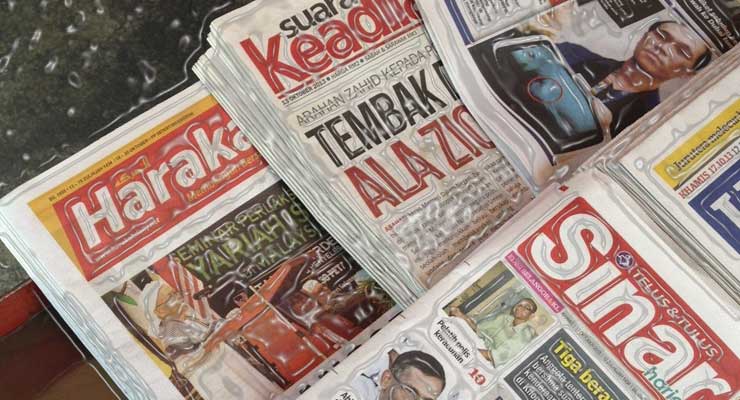

Malaysian journalists are enjoying unprecedented freedom in the wake of the unexpected ouster of a government that had combated critical media with court cases and harassment.
For defiant outlets such as Malaysiakini that had braved the wrath of ousted Prime Minister Najib Razak to pursue massive corruption allegations against him, life has just become easier.
But with Najib’s corruption case now leading news on major networks, it is in the mainstream media that the real change is happening, Malaysiakini’s editor-in-chief Steven Gan says.
“I’ve been a journalist for over 25 years in Malaysia. I think this is the first time that I feel optimistic that there will be greater freedom, not just of the press but also of expression, of speech for Malaysians,” he said.
“For the mainstream media which has been operating under a short leash because of the control of the government, definitely that leash has gone and their reporting has undergone quite major change.”
Mixed messages though from the coalition that ended six decades of one party rule in Malaysia in May has made some media watchdogs nervous about how unified their media reform commitment really is.
Pakatan Harapan, an unlikely coalition of parties led by longtime opposition nemesis and former PM Mahathir Mohamad, built media reform into their party manifesto.
However Mahathir has a legacy of shutting down news outlets from his previous 20-year stint as prime minister and his enthusiasm for press freedom appears colder than that of his coalition partners.
“You see I practice not the same kind of liberal democracy that you find in America or in other countries but we have constraints here. We have a multiracial population that if it’s not managed well will soon go into conflict and even fight each other,” he told VOA in a recent interview.
“So we watch carefully to see that when you publish anything it is not deliberately in order to stir up racial feelings. If you do that then we have to restrict you. But otherwise in Malaysia there is freedom of the press,” he said.
Mahathir has long argued that Malaysia’s delicate ethnic balance of Malays, Chinese, Indians and others is so sensitive certain rights must be curtailed.
Ed Legaspi, executive director of the Southeast Asia Press Alliance, said it was not surprising for him to return to this theme but that it is time he realized the public has moved on.
“He needs to change his views about media freedom in Malaysia. I think Malaysia has matured enough as a society. In fact that’s what the people chose during the election so he must listen to that mandate to reform the freedom of expression environment in Malaysia,” he said.
“As a leader he has no record of allowing freedom of expression. He says he has changed but we’ve yet to see how his party, that came from UMNO, will support the reform,” he said, referring to the United Malays National Organization party Mahathir led as prime minister from 1981 to 2003.
Initially he moved it towards liberalization but then reversed course— forcing the closure of several critical newspapers in the late 1980s while detaining waves of political opponents.
His relationship with online freedom has vacillated as well. In the late 1990’s Mahathir committed Malaysia to “no internet censorship” under the Multimedia Super Corridor initiative— a project intended to attract dotcom boom investment.
Later, he changed his mind after alleging Facebook had censored one of his posts attacking Israel’s treatment of Palestinians that, among many points, claimed Jews took pleasure from killing Arabs.
The “no internet censorship” commitment was now regrettable, he declared, as companies already censored the web but allowed content morally offensive to Malaysians.
More recently Mahathir caused anxiety by signaling, perhaps unintentionally, that he intended to amend rather than scrap a deeply unpopular fake news law.
On May 22 a coalition of 20 Malaysian rights groups, riled by that development, publicly urged the new government to make good on its election promises, and it has since pledged to fully repeal the law at the first sitting of parliament on July 16.
The fate of other laws Pakatan Harapan pledged to repeal, such as the 1984 Printing and Publications act, which grants the home minister “absolute discretion” to ban or censor “undesirable publications” and elements of the 1998 Communications and Multimedia Act, remains a concern.
Malaysiakini’s Steven Gan thinks Mahathir won’t betray the very different expectations of the electorate that brought him to power this time, even if his heart is not completely with them.
“Well Mahathir’s an autocrat when he was in his first stint as prime minister about 20 years ago. There’s definitely a question of how far he is willing to go,” he said.
“But I think that he has gone quite far given that he is not known to be a democrat. I think that he has gone quite far in trying to meet the aspirations of Malaysians and Malaysians who voted this new government in power, and I think they definitely watch every [one] of his steps.”
Leave a Reply