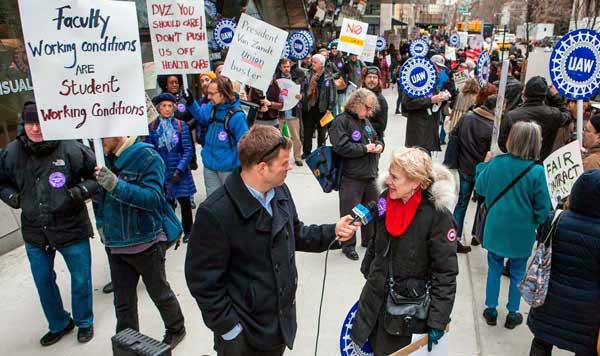
In mid March, The New School was having problems with its contract negotiations, and Brian Caterino, who had taught there years before as a contract worker — though he was paid the same measly compensation adjunct faculty were paid — commented that this was nothing new.
I asked him if he would write something about this, and he did…
by Brian Caterino
A few weeks ago, part time faculty at The New School held a day of protest over stalled contract negotiations and work conditions. The part timers who teach 85% of The New School courses have been without a contract since August 2014. The current proposals included reductions in health care benefits to part time faculty and other cuts. Part time faculty want — among other things — better health care benefits, adequate payment for online courses, and job security. They point out the discrepancy between the wages of part timers and the extravagant salaries paid to some faculty and administration while others just scrape by.
While part time faculty make about $16,000 per year, the President of The New School, David Van Zandt, earns over $700,000, and Vice President and CEO James Murtha over $1.2 million. The New School also opened a new building at the cost of $352 million.

These compensations continue the precedent set when ex US Senator Bob Kerrey became president. Not only did he get over $900,000 yearly salary, but also he received a $1.2 million golden parachute when he left in 2010 and continued getting a six figure salary as emeritus president.
Under Kerrey, The New School was reorganized to follow the model of the corporate university rather than the progressive university founded in 1918 by war protesters dismissed from Columbia University and supported by Charles Beard and John Dewey.
Yet the problems at The New School did not begin with Kerrey. This kind of treatment of adjuncts is nothing new at The New School. In the late 90’s, I was involved in a project funded by FIPSE to develop the existing online DIAL program at The New School. This was a distance learning experiment, as most of the faculty lived outside of New York City.
When I got involved, I was somewhat stunned to find that the pay for online faculty was only around $1000 per course; that was considerably lower than the already poor wages I received teaching part time at a SUNY campus in New York state.
As the project unfolded, it came out that one of the rationales for expanding this program was to generate revenue to support full time faculty. It was assumed that the part time faculty taught elsewhere, and this was just a side gig where they would use material they already had.
Of course this was not true.
Many either had no jobs or were part timers, and although I might have been the loudest voice to complain, few were happy with this situation. Because a lot of us were unhappy, the project was terminated and many of us were too.
I wrote a letter to Lingua Franca criticizing them, but I don’t recall any response. Being far away from NYC, I was pretty much isolated form the situation.

I really expected more out of The New School, but I can’t say I was totally surprised. The seeming willful ignorance of the situation of part time faculty still reigned. Though I liked the person in charge of the FIPSE project, she seemed to have little notion of the depth of the problem. She claimed to be a kind of Frankfurt critical theorist.
Other critical theorists there — some of whom I had met as a graduate student and had some contact with — did not as far as I could see speak up or help. Certainly no tenured faculty contacted me with any message of support.
But then they never do.
One well known faculty at The New School who will remain nameless mentioned something about problems in an interview I read several years later, which I can summarize as follows. “It’s up to adjuncts to organize and do something about it…”
That’s it.
Some of these same people were prominent critics of Kerrey’s economistic model years later when he took office.
Not being there I can’t say for sure, but every account I read focused on the lack of faculty autonomy and consultation, not on the treatment of adjuncts.
I guess what I got out of the experience was a deepened sense of the alienation from academia that I already felt. Not only in the face of the intransigence of administrators but also in the willful ignorance of faculty to the conditions developing around them… I felt betrayed.
By the late 90’s it was not news that contingent employment was taking over academia. Earlier when I got out of grad school, faculty seemed to think that the part time trend was a blip and that employment would pick up. Even they missed the boat on the real causes of the adjunct problem.
When things changed they never caught up.
In some disciplines like philosophy, which had been expecting job shortfalls for years, students were subject to a rather draconian ranking system. In the philosophy department at a school I attended, faculty would support a small group of those they saw as their star students and push them for jobs; the rest were on their own. Faculty — whatever their ideological stripe — simply accepted the logic of the market and never bothered to look at the forces that were shaping the market and their own profession.
Now that things are so apparent that they cannot be denied, they are paying attention.
Given the strength that the forces of marketization have gathered, it might be too late to change things. If they had woken up and acted earlier, we might not be in this situation. But I have come to believe that most tenured faculty are — despite the usual slings and arrows of fortune — happy and secure and have little interest in what comes after they retire.
In the end, I did not leave academia, though it left me.
Despite the fact that I had some really strong recommendations and have — in rather trying circumstances — managed to publish articles and edited a pretty well known collection in my field, I could never even get a look for a full time position, As I got older too, I found that younger, more compliant people got even the crumbs of part time work.
That’s not a way I was willing to live.
Needless to say, I do not have a lot of respect for my academic colleagues.
For the most part they are phonies who are impressed by pedigree academic or familial, and who defend their position and privilege with pieties about the academy for tenure as a bastion of critical thought, while their peers are struggling.
Support for adjuncts is totally lacking.
The more my situation became desperate, the more I was hung out to dry by full time faculty and peers.
The author of the aforementioned article on The New School protest was a student at The New School just a few years ago and notes the increasing culture of alienation between students, faculty, and administration. While I know full time faculty were extremely unhappy with Bob Kerry, and they gave him a vote of no confidence in 2008, still I did not see the displeasure extended to the teaching conditions of part timers.
I just read another report, this one from the California Faculty Association, which stresses the economic insecurity of our times. They are increasingly discouraged and frustrated with little hope for their own future and that if their profession. The constant anxiety over jobs and money is a real soul destroyer.
I don’t know anyone who would want to do it anymore.
Letter to Lingua Franca is written below, for your convenience. It is dated August 1997, New York City:
“I do not condone all of the Mobilization’s proposals for change at The New School, nor its offensive attacks on individuals like Nancy Fraser. However, if The New School administration is as unresponsive to student concerns as it has been to those of part-timers, I can understand the students’ frustration. I am a contract instructor offering courses in the on-line DIAL (Distance Instruction for Adult Learning) program. As an “independent contractor,” I am barred from listing myself as a member of the faculty or as an affiliate of The New School. This bit of legal legerdemain allows the school to avoid paying social security, let alone pension or health care.
Already, it pays some of the lowest part-time wages I have encountered, $965 per course. Moreover, we have been told that we should not expect raises because the adult division is designed to subsidize the other — presumably more important — academic divisions. Nevertheless, we are told how lucky we are to teach at The New School, where we can offer the courses we choose.
Despite our low wages and lack of job security, our love of teaching and our dedication to our work are supposed to justify sacrifices no tenured academic is asked to make. If tenured faculty at The New School, are sympathetic to legitimate institutional reforms, they should demonstrate their commitment by working toward living wage and decent benefits for part-time faculty.”

Brian Caterino is an independent scholar who lives in Rochester, NY. He works in non profit independent media and is the co-editor (with Sanford Schram) of Making Political Science Matter and articles on critical theory, social theory, and social science research. He has also published in Perestroika: the Raucous Rebellion in Political Science as well as articles and reviews in a number of journals. His most current publications are “Phronesis and the Participants Perspective” in The British Journal of Sociology (Volume 64, Issue 4, December 2013) and “Lowering the Basement Floor From Community Colleges to the For-Profit Revolution” In New Political Science.
Leave a Reply