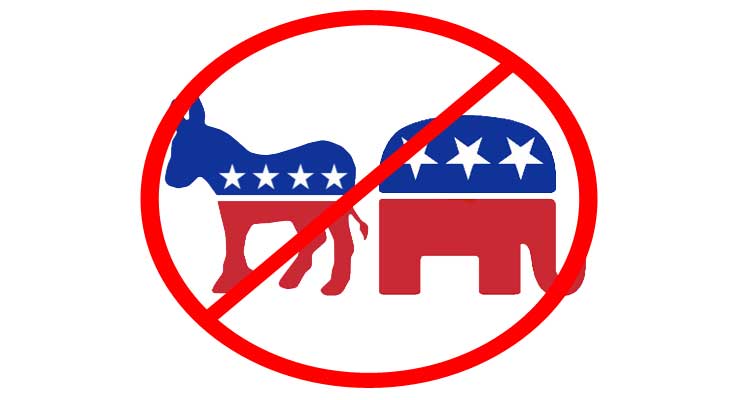
Nonpartisan elections are in the spotlight again. A new post by Richard Winger at Ballot Access News had the announcement from Davenport, Florida that on “April 3, Libertarian Party member Brandon Kneeld was elected to the city council”. Davenport is a very small city of in central Florida’s Polk County but the win demonstrates the potential benefits of nonpartisan voting for independents and third party candidates outside the American two-party system. The Florida Libertarian Party added in their announcement of the victory:
Kneeld easily defeated his opponent, Headley Oliver, with 245 votes to Oliver’s 117. “I’m just incredibly humbled they’re putting their trust in me,” Kneeld said of the residents, in an election-night interview with the local newspaper, the Ledger. “I’m just excited to try to do my part to keep Davenport a wonderful place to be.” The term for the office is three years. Kneeld’s election brings the Libertarian Party’s number of elected officials to 162. (They are listed at LP.org/elected-officials-2.)
A review by the National League of Cities found that valid arguments in opposition to nonpartisan ballots include that “In the absence of a party ballot, voters will turn to whatever cue is available, which often turns out to be the ethnicity of a candidate’s name.” They also found that there are worker/labor opposition as “nonpartisanship tends to produce elected officials more representative of the upper socioeconomic strata than of the general populace and aggravates the class bias in voting turnout, because in true nonpartisan systems there are no organizations of local party workers to bring lower-class citizens to the polls on election day.”
Some maintain however that the use of nonpartisan elections can be a boost to competition in small towns following the widespread use in big cities with New York City being an outlier by still not using the system. An article in the Gotham Gazette by the widely respected academic Frank Macchiarola passionately made the arguments in favor of using the nonpartisan elections system in NYC:
“In more than 80 percent of the nation’s largest cities, mayors are elected through nonpartisan elections — elections in which the candidates do not run on the Democratic or Republican or any other established party line, but as individuals. The cities where there are nonpartisan elections include Los Angeles, Chicago, Houston, Detroit, Denver, and San Francisco. New York City is the exception.”
He added:
The system is indeed broken. The city’s independent voters, ever-growing in number, are effectively disenfranchised, since the party primary decides all but a few elections. As the noted political scientist V.O. Key wrote about the segregated south, a one party system is the functional equivalent of a no party system.
For an in-depth exploration of the pros and cons of nonpartisan elections, this video shows a landmark six-hour Election Law Symposium titled “Assessing the Nonpartisan Model in Election Administration, Redistricting, and Campaign Finance” that was held on September 14, 2012 at the University of California, Irvine. The symposium was described as:
For many years, especially since the 2000 presidential election controversy, scholars have debated whether nonpartisan actors should replace partisan actors or a bipartisan commission in administering elections, conducting redistricting, and policing the campaign finance system. Some states recently have adopted more nonpartisan models, including California’s redistricting commission and Wisconsin’s Government Accountability Board, although most states have retained partisan or bipartisan control.
This symposium, sponsored by the UC Irvine School of Law, the UC Irvine Law Review, and the UCI Center for the Study of Democracy will offer empirical, legal, normative, theoretical, and historical perspectives on the use of partisanship in the agencies governing election administration, redistricting, and campaign finance laws. How should the success or failure of such institutions be assessed? Are nonpartisan agencies normatively preferable to partisan and bipartisan agencies in achieving the goals of the political system? What explains why jurisdictions adopt or fail to adopt nonpartisan institutions? The symposium will bring together leading scholars in the field of election law and political science to consider such questions in the weeks leading up to the presidential election of 2012.
Take a look:
Leave a Reply