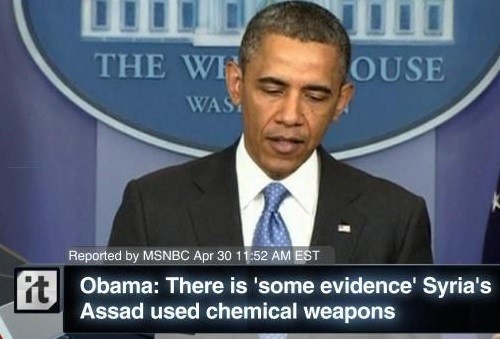
When President Obama declared the use of chemical weapons as the “red line” for the Assad regime, policy critics were quick to describe the warning as a mistake. The primary concern was that President Obama’s decision to publicly guarantee American aid to the Syrian rebels would bind American policy options if President Bashar al-Assad chose to ignore the warning. Unfortunately, he did. In response, the Obama administration has committed to sending small arms and ammunition to the Syrian rebels to assist in their overthrow of the Syrian government.
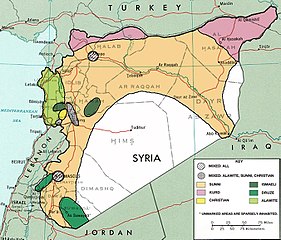
President Obama’s decision to send small arms and ammunition as part of an increased commitment to the rebellion has come under scrutiny for a variety of reasons. Many observers feel that shipments of small arms would be ineffective against the heavy weaponry and modern equipment of the Syrian army.
Louay al-Mokdad, the political and media coordinator for the Free Syria Army commented that the aid is too little too late: “We welcome the decision, but it is a late step. And if they send small arms, how can small arms make a difference? They should help us with real weapons, antitank and antiaircraft, and with armored vehicles, training and a no-fly zone.” In addition, arming the rebels will lead to an escalation of the conflict, but the aid is not decisive enough to shift the balance of power dramatically; the Obama administration has undoubtedly considered the possibility of a prolonged, more deadly war as a result of the aid.
If the decision to send aid to Syrian rebels was a forced commitment because of the “red line” statement, it would be easy to characterize the warning as a blunder on President Obama’s part. The most scathing characterization of the aid would be that it was an attempt to maintain credibility rather than a profound concern over the use of chemical weapons.
Obama and Syria Chemical Weapons
Despite the fact that the warning has failed to deter the use of chemical weapons, it still would be incorrect to describe the act of warning against the use of chemical weapons as a mistake. While governments reserve the right to lethal force as a last resort, there is a broad consensus on the prohibition of chemical weaponry (see 1993 Chemical Weapons Convention). Some may consider it odd that death by conventional weapons is considered more humane than death by chemical weapons, but the nature of chemical weapons makes its use a particularly odious offense. Chemical weapons are inherently indiscriminate; both combatants and non-combatants can be exposed to toxic agents in the air.

Conventional weapons can certainly be used for indiscriminate killing, but the chemical weapons are used with the intent of indiscriminate killing. The divide between combatant and noncombatant is a line that chemical weapons wholly ignore. These weapons do not simply ignore the divide; often, the groups that are best equipped to survive a chemical attack are legitimate military forces with proper protective gear. Civilians, however, are not as well equipped to deal with exposure to chemical agents. In this way, chemical weapons are deadliest in civilian populations. Its effectiveness is directly related to the fact that these weapons target the most vulnerable and the most helpless segments of a population.
Reading Obama and Syria
Critics can argue whether or not President Obama’s warning was a strategic move for the U.S. The Obama administration now finds itself bound by its obligation to the Syrian rebels and its commitment to a peaceful resolution of the civil war. However, a strong stance against the use of chemical weaponry was necessary and the best course of action. When dealing with problems like weapons of mass destruction, we must remember that they are not simply issues of statecraft; they are issues of humanity. Our foreign policy ought not be formed simple strategy, but practical action based on a set of principles that aim to uphold human dignity worldwide.
Adrian Tawfik says
The author is very right. But I also think that Obama is trying to have a light impact in Syria on purpose. The fact that we didn’t set up a no-fly zone in the north of Syria after Obama’s chemical weapons nnouncement was surprising to me. I think if we are to get involved, then we better win. Assad needs to lose at least and then the rest is up to the Syrians.