Remember that the major parties shouldn’t be the ones deciding whom Americans get to hear from. It’s not their Presidential debate. It’s yours, America!!!
Next year will be an election year, and there are some happenings we’ve come to expect. One is that everyone will make their candidacy announcements ridiculously early. Check.
Another expectation is that when the debates come around, the candidates will happily go through the Commission on Presidential Debates—a private organization run by former heads of the major parties. The Commission’s presence means that not only will there be no real debate, but candidates will have to be Democrat or Republican to participate.
As you’d expect, this exclusion infuriates a lot of people, including a recently formed group called the Our America Initiative. They’re suing. Plaintiffs include all the 2012 presidential and vice presidential candidates from the Libertarian, Green, and Justice Parties.
The major parties have incensed a lot of people with the way they’ve conducted themselves surrounding the debates. The League of Women Voters were particularly angry. When they stopped sponsoring the debates back in 1988, they accused the major parties of “perpetuating a fraud on the American voter” with their “unyielding and self-serving demands.” The Commission on Presidential Debates then zoomed in to fill the League’s place.
It may have appeared that the Commission had some modicum of decency when they permitted Ross Perot to debate in 1992. In reality, Perot was in the debate only because the former President Bush wanted him there. Note that when Perot was allowed in the debate he only polled at 7%. After the debates, his numbers nearly tripled to 20%. Mind you Perot is polling at 20% under plurality voting, so his actual support was surely much greater under a reasonable voting method like approval voting.
In 1996, Perot was one of six candidates on enough state ballots to technically win the presidency. Perot, polling similarly to before the debates in 1992, was excluded. The Commission’s rationale was that because Perot accepted public funds he would be limited in his personal spending—and this limit would make him an unviable candidate. Perot, a billionaire, said he would have refused the funding had he known the Commission would use this (after-the-fact) reasoning.
The Commission’s strange rationale fueled the frustration of George Farah, an idealistic Harvard-educated attorney who formed the nonprofit Open Debates. Open Debates gained attention in 2004. Since then, Farah has blocked aside time every four years to humiliate the Commision and major parties on national news. He’s also written what is surely the best book on the Commission: No Debate.
In 2008, Free and Equal, founded by Christina Tobin, sponsored a third-party debate which included all the candidates on enough state ballots to technically be able to technically win. Free and Equal repeated this in 2012, when it had Larry King as the moderator. Note that the most candidates ever participating in these debates was four—far fewer than the number of candidates in major party primary debates.
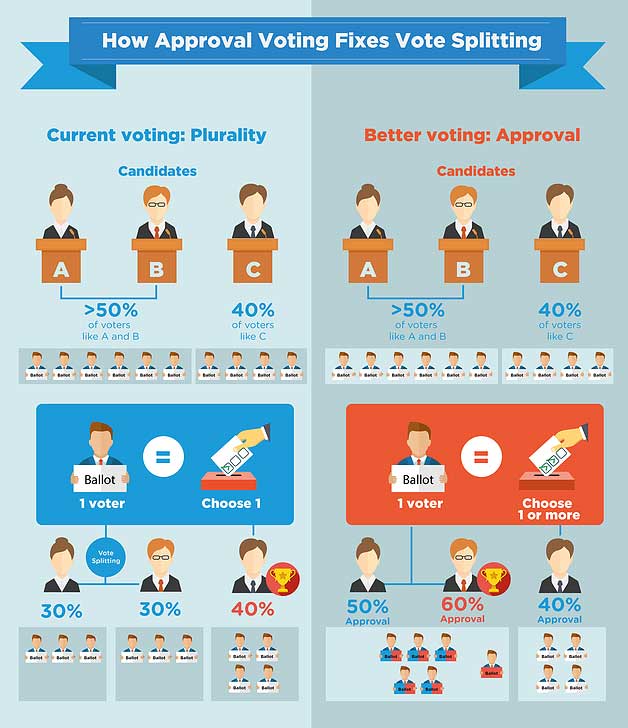
Part of the argument for excluding candidates is that major parties don’t want to risk vote splitting—the dividing of votes among similar candidates. This is one of many reasons why we need approval voting. It fixes this issue and is a much better solution than excluding political speech.
As the elections get closer, and you’ll inevitably hear excuses for why no one else should be in the debates. One Commission representative, Dorothy Ridings, made the claim that they had to make sure “27 people” weren’t on stage—which we know is absurd from the way Free and Equal was able to reasonably limit their participation in both their 2008 and 2012 debates.
Bizarrely, Ridings went on to say of the Commission that, “There is no right and wrong policy.” Except that there is a right and wrong way to conduct political debates. And the Commission’s approach is wrong. Further, this is essentially the major parties carrying out these debates. After all, they can go with any debate organization they choose. Many organizations have offered!
Remember that the major parties shouldn’t be the ones deciding whom Americans get to hear from. It’s not their debate. It’s yours.
Greg says
Great article Aaron at the right time. We need to continue harping against the Commission. It’s embarrassing these debates are dumbed down. Your absolutely right it is our debates. To whom shall we best voice our opinion regarding approval voting?