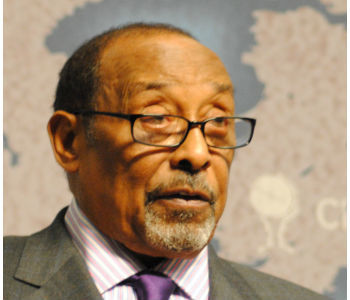
The theft of a large amount of data from Somaliland’s Immigration and Intelligence Department has caught the region by storm. Members of Somaliland security personnel have been said to have gone into hiding for fear of their lives as their personal identities were exposed. Sensitive security files and military uniforms were among the items stolen but more at stake is Somaliland’s “autonomy”. The semi-autonomous government of Somaliland, still attached officially to Somalia, has so far kept silent on the matter to avoid further evacuations of expats and global isolation. Behind the theft, many security experts blame an over-ambitious reorganization of vital organs of the state such as Secret Service and the Presidential Office led by former guerrilla turned president, Ahmed Mohamed Mohamoud “Silanyo” (احمد محمد محمود سيلانيو).
Somaliland security changes bring trouble
 During the term of previous President Dahir Riyale Kahin, a regional chief spy was suspected of having links with violent Somali insurgent group Al-Shabab and of being involved in the theft of state secrets. Riyale overheard the story and cleverly dealt with the matter by simply restricting the chief spy’s access to vital institutions unwittingly without alerting him of any wrongdoings, even leaving his salary as it was.
Since taking control of the Presidency in 2010, the new President, Silanyo, has begun a campaign of vast changes in the security forces with the help of his apparent heir jack-of-all-trades and the Minister of the Presidency Hersi Ali Haji Hassan. None of Somaliland’s veteran experts are familiar with those now running the security apparatus of the country and individuals with dubious backgrounds have been allowed in the security services. Under Riyale, Scotland Yard and British international security trainers had mentored a team of veteran security staff to protect the nation’s security but today none of them remain in the office and the reasons of their eviction remains a mystery.
Placement of staff in the most vital institutions including the military and police is now regularly accomplished via political inheritance and clannish “nepotism”. The turnover of the intelligence personnel and continuous rate of replacement in Somaliland are some of the highest in the world. Amateur officials don’t have the training to do their jobs and often unintentionally divulge secret data in public releases. Receiving their credible information from private sources, many governments and NGOs discard the Somaliland government’s official security updates, widely considered to have misleading information. Data sharing system with many foreign countries has been kept on hold as a result.
Impact on Somaliland security of foreign religious fundamentalism
Unfortunately, the murder rate exponentially increased recently despite the reinstallation of some ex-security personnel from the Riyale era like the interior minister Ali Waran’adde. The security nucleus continues to be run by unknown figures whose loyalties have been widely questioned. Dozens of innocents were brutally murdered in the last few months, and in the last week, a teenager was stabbed to death in broad daylight in Somaliland’s capital, Hargaysa. This bleak security environment coincides with the insurgent group Al-Shabab adapting more large scale attacks on non-military targets like the Westgate Mall in Kenya.

In the last month, between 45,000 and 67,000 ‘Talibs’ or so-called pupils graduated from unregulated Madrasas in Hargaysa. These Madrasas operate in a Kandahar-like unfettered environment. Somaliland Educational Minister Samsam, as good as she could be in my opinion, cannot dare to ask the names of the Talibs before they finish their dubious courses. One thing is certain: they are not ending up in Somaliland where their effort is desperately needed. Instead, their families are often informed years later that they should mourn silently. This silence is to ensure the Sheikh who dispatched the youth to fight in Somalia or elsewhere remains anonymous to avoid family vendetta.
Last year, Dr. Bilal Philips, a new convert to radical Islam from the West, ironically preached to our president Silanyo and his allied Sheikhs, lecturing them on how to say prayers and so on. Lecturing about Islam to Somalia, which has the highest percentage of Muslims anywhere in the Islamic World, is like lecturing about Christianity in the Vatican!
Leaving Somaliland security troubles behind
The businesses and organizations who have been evacuating the country speak volumes of how far the security decline has reached. On January 27th of last year, the Guardian ran the article “Britons warned to leave Somaliland after ‘specific threat’”. The British government called on her subjects including dual citizens to evacuate Somaliland immediately because of “kidnapping for financial or political gain, motivated by criminality or terrorism, remains a threat throughout Somalia”. Just weeks later, the United Nations Development Program (UNDP) head office in Mogadishu came under brutal attack as terrorist gunmen wearing Somalia’ TFG uniforms killed foreign residents in the compound. The UN agencies in Somaliland have often had to lower the security level to orange and withdraw their international staff when security arrangements are in breaking point. On 14 August, 2013, Médecins Sans Frontières declared the eventual shutdown of all running projects in Somalia including Somaliland security concerns.
Again in the same month, the World Street Journal announced “Anglo-Turkish oil company Genel Energy PLC has started pulling its employees out of northern Somalia following a sudden spike in violence in the volatile Horn of Africa nation”. Genel Energy, exploring oil in nearby Buroa, Togdheer, and Somaliland, evacuated its personnel in a particular hurry, leaving expensive machinery behind. The exit of Genel Energy is a major threat to the country and is a heavy blow to the region’s economic prospect. To me and other concerned citizens, the withdrawal of these organizations wasn’t just disappointing but also very devastating. Somaliland needs stability and security more than ever.
Leave a Reply