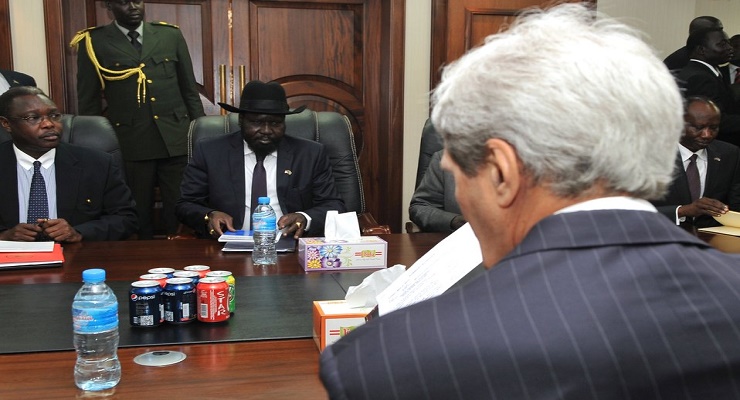
South Sudan’s warring parties signed what they call a final peace agreement to end a civil war that killed tens of thousands of people and displaced millions. The deal, signed in the Ethiopian capital Addis Ababa on Wednesday, was witnessed by Ethiopia’s Prime Minister Abiy Ahmed and other regional heads of state. Juba town residents say they are cautiously optimistic peace will return to their country.
Emmanuel Agele, who resides in Juba’s Gudele suburb, believes peace will prevail.
“Surely it’s going to hold because everybody is tired of war, the war has changed the situation of the country completely, and I’m sure that everyone doesn’t want that kind of situation to go on whether on the side of the opposition or the government; all the people are now desperate,” Agele told South Sudan in Focus.
Juba lawyer Buot Manyel Buot said he hopes the signing means the country’s leaders have learned from their mistakes.
“We have seen previous peace agreements signed, we have seen citizens’ jubilation but eventually we didn’t see results so hopefully this time around our leaders have learned the hard way and by saying this, we mean guns have to be silenced, [and]IDPs have to be repatriated back to their homes,” Buot told South Sudan in Focus.
Atem Jong Ahai, a University of Juba student, said he is skeptical there will be lasting peace. Ahai said he still has vivid memories of what happened in July 2016 at the presidential palace in Juba.
Matur Dhor Kachuol, another University of Juba student, saidthe country’s leaders should sympathize with citizens.
“We feel very sad, we feel discouraged. We feel the reason why we fought for independence is not what has been actually realized in the country,” Kachuol told South Sudan in Focus.
Peace activist Joseph Oliver told VOA young South Sudanese should monitor the deal’s implementation.
“Over all these years implementation has been a challenge, so my call to the youth is to start looking up and coming up with strategies how to follow this that we can participate actively,” said Oliver.
Tut Kew, President Kiir’s adviser on security, told reporters atJuba International Airport awaiting Kiir’s return Thursday that the agreement marks an end to violence in South Sudan.
“The President has signed the peace in Addis. There will be no more conflict in South Sudan. All opposition parties have also signed the peace agreement,” Kew told VOA.
The deal reinstates Riek Machar as vice president during a 36-month transitional period.
Information Minister Michael Makuei has said several times that IGAD (Intergovernmental Authority on Development) mediators should not allow Machar to work with Kiir again, and that Machar should only reside in South Sudan as a citizen.
Tut Keu said those differences have been put aside.
“All the outstanding issues, we have resolved them and everybody signed. Actually the unresolved issues were simple ones that cannot bar the signing of the peace agreement, those were just political issues,” said Tut Keu.
But the agreement still leaves many contentious issues unresolved, including the number of states and their boundaries. Kiir years ago unilaterally increased the number of states from 10 to 32. Unresolved issues are to be settled by heads of state at IGAD.
Juba resident Paul Malual AJak wants to see the deal implemented immediately.
“I want our leaders on the top [like]our dear President Salva Kiir to encourage our politicians from different opposition so that they come together as one family so that we carry out development because development cannot come unless our politicians have a political will,” Ajak told South Sudan in Focus.
The National Salvation Front and the People’s Democratic Movement refused to sign the deal. National Salvation Front leader General Thomas Cirillo has said he refused to sign because the agreement does not address the root cause of the conflict in South Sudan.
Leave a Reply