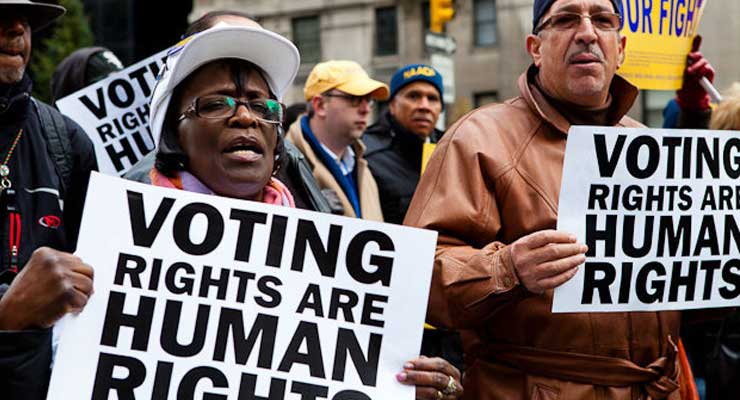
A surprisingly good year of progress in state felon voting rights has enfranchised thousands
From the American Prospect:
Millions of Americans will cast ballots on Super Tuesday and in November, but many people will have no choice but to stay away from the polls. State felony disenfranchisement laws in 48 states prevent nearly six million citizens from exercising their voting rights, according to a 2015 Sentencing Project policy brief. More than two million, or nearly 40 percent, of these disenfranchised people are African American.
Felon voting laws vary widely, from allowing convicts to vote while in prison to permanent disenfranchisement. Several Super Tuesday states allow some ex-offenders to vote if they meet certain conditions. Although Virginia Governor Terry McAuliffe relaxed some of the rules regarding restoring voting rights to ex-felons, people who served time for violent offenses must wait three years before applying to have their rights restored. They also must not have any outstanding fines, damages owed to victims, or court costs. In the Old Dominion State, the racial disparities are particularly pronounced: 20 percent of black adults in Virginia are disenfranchised.
In Tennessee, people who have committed certain violent and sexual crimes are permanently banned from voting. Notably, the Volunteer State also bars ex-felons from voting if they are not up-to-date on child-support payments. But similar to Virginia, certain Tennessee ex-felons are eligible to vote: Those who are eligible can apply for restoration of their voting rights only after they have completed their entire sentence or fulfilled any parole or probation conditions and have paid any court-ordered restitution damages.
Wyoming, which holds its Republican caucus on Super Tuesday, passed a law in 2015 that required the state’s Department of Corrections to issue a certificate of voting rights to first-time, nonviolent offenders after their release from prison. Prior to this change, first-time nonviolent offenders in Wyoming could only apply to have their voting rights restored five years after completing parole and probation. (People convicted of violent or multiple offenses are permanently disenfranchised.)
The movement to end disenfranchisement has a broad base of support from criminal justice reform advocates and voting-rights advocates alike. And getting ex-offenders registered to vote is a successful re-entry strategy. “Over the last few decades, a lot of states have been taking positive steps,” says Tomas Lopez, a counsel at the Democracy Program of the Brennan Center for Justice at New York University’s School of Law. “We want people civically engaged.
Elsewhere, Maryland recently changed its policies on felony disenfranchisement. Democratic state lawmakers introduced a bill that sought to restore voting rights to felons upon their release from prison, rather than having people wait until they complete parole and probation.
The bills passed the legislature with overwhelming bipartisan support only to be vetoed by Republican Governor Larry Hogan. However, state lawmakers overrode the governor’s veto, restoring voting rights to 40,000 Marylanders. “If you’re living and working in the community, you’re allowed to vote,” says Lopez, describing the new law.
In an attempt to alleviate overcrowded prisons, California lawmakers passed a series of bills in 2011 that would have placed low-level felony offenders under community supervision in county jails and allowed others to be monitored by county agencies instead of state parole boards.
But California’s then–Secretary of State Debra Bowen ruled that community supervision was essentially the same as being on parole, so felons being monitored by counties were still ineligible to vote. Three years later, civil-rights groups, including the American Civil Liberties Union of California, sued Bowen, asserting that the she had stripped tens of thousands of citizens of their right to vote.
Alameda County Superior Court Judge Evelio Grillo sided with the civil-rights groups, but the state appealed the ruling. Last year, current California Secretary of State Alex Padilla finally dropped the appeal, which effectively restored voting rights to 60,000 Golden State ex-offenders.
Kentucky made some strides and then saw a reversal. Former governor Steve Beshear, a Democrat, issued an executive order that restored voting rights to approximately 100,000 citizens with nonviolent felony convictions. However, new Republican Governor Matt Bevin reversed the order during his first days in office last December, saying that the matter must be left to the state lawmakers and the “will of the people.” Even though restoring the right to vote in Kentucky had bipartisan support, the Bluegrass State now rejoins Iowa and Florida as the three states that have permanently disenfranchised felons, no matter what type of crime they have committed.
This sort of backtracking is troubling. “Denying the right to vote to an entire class of citizens is deeply problematic to a democratic society and counterproductive to effective reentry,” the Sentencing Project concluded in its report.
Leave a Reply