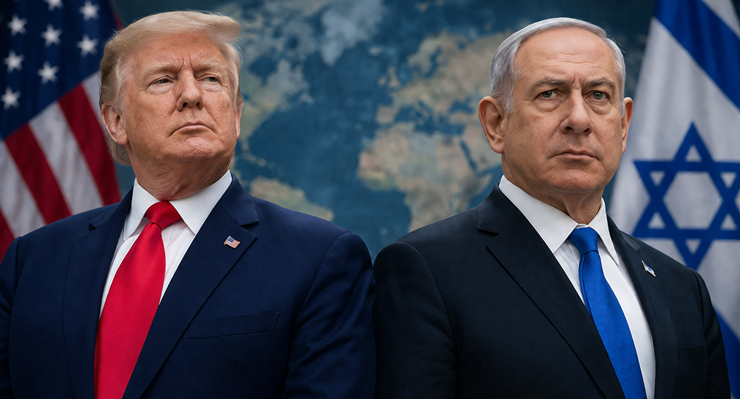
We couldn’t have two less suitable political leaders at a moment when the world desperately needs diplomacy. With fears of a wider regional conflict growing, and some warning of the possibility of a third world war, the quality of leadership matters more than ever.
In my view, both Donald Trump and Benjamin Netanyahu are driven by immense political ambition and personal political survival. Their critics argue that each has strong personal incentives to remain in power, and that reality inevitably shapes the decisions they make. Whether fair or not, it raises uncomfortable questions about how personal interests can intersect with matters of war and peace.
Both leaders have adopted highly confrontational political styles, often defining politics in terms of enemies and existential threats. While such rhetoric can be politically effective, history reminds us that it also carries risks, particularly when tensions are already running high. The danger is that once leaders frame conflicts in absolute terms, compromise becomes increasingly difficult.
The relationship between Trump and Netanyahu is one of the closest and most consequential political partnerships in recent years. They appear to share a strategic outlook on the Middle East and have consistently reinforced one another’s positions. Whether this alignment ultimately serves long-term regional stability remains an open question.
Trump has never struck me as a leader guided by a consistent moral compass. Rather, his politics often appear driven by personal conviction, instinct, and a preference for confrontation over compromise. His refusal to concede defeat or publicly acknowledge mistakes has become a defining characteristic of both his business and political careers.
That style was shaped, in part, by his mentor and former attorney Roy Cohn, whose aggressive legal and political tactics during the McCarthy era became well known. Trump’s approach has long reflected the philosophy that admitting fault is itself a form of defeat.
Long before entering politics, he attracted criticism over business practices involving contractors, investors, and customers. Many of those disputes contributed to a public perception that his commercial interests frequently took precedence over those of others. Whether one accepts that assessment or not, it continues to shape how many people judge his presidency.
For these reasons, I find it difficult to place complete confidence in his leadership during an international crisis.
Netanyahu, meanwhile, is a formidable political figure. Even those who disagree with him generally acknowledge his intelligence, determination, and ability to persuade. He projects confidence and certainty, qualities that have helped him remain one of Israel’s most dominant political leaders for decades.
It has often been suggested that even experienced world leaders found him an exceptionally persuasive negotiator. Whether or not every story about those encounters is accurate, his reputation as a skilled political strategist is well established.
My concern is that the current confrontation with Iran may be viewed too optimistically by those advocating military action. Comparisons with Iraq seem misplaced. Iran has a population roughly four times larger than Iraq’s and possesses far greater industrial, technological, and military capabilities than Iraq did in 2003.
Any conflict involving Iran would almost certainly be more complex, more expensive, and considerably more difficult to contain.
I struggle to imagine two leaders less suited to a moment that demands patience, restraint, and diplomacy.
Knowing the stakes leaves me wondering what sort of world we are handing to future generations. It is an unsettling thought.
I do not hate either man. They are both products of their own political systems and convictions.
I simply wish that, at this particular moment in history, different leaders were occupying these offices.
The policies they are pursuing offer me little reassurance. The path they are attempting to navigate carries enormous risks: the loss of human life, severe economic disruption, regional instability, and the possibility of escalation well beyond anyone’s original intentions. The potential costs seem, to me, far greater than the possible gains.
I also question whether diplomacy was ever fully exhausted before military confrontation became the preferred option.
The greatest fear is that miscalculation could produce consequences far beyond the intentions of any single government. Even if nuclear weapons are never used, the possibility of wider regional escalation should concern every responsible leader.
I also believe that the decision by President Trump to withdraw from the Iran nuclear agreement represented a turning point. Whatever its imperfections, many observers believed the agreement had succeeded in placing meaningful constraints on Iran’s nuclear programme. Its collapse removed one of the few diplomatic mechanisms available for managing tensions.
The ethical and strategic choices made by political leaders deserve careful scrutiny. They should never be accepted uncritically simply because they promise short-term political advantage or ideological satisfaction.
If today’s decisions prove to be miscalculations, the consequences will not be borne by political leaders alone. Ordinary families, soldiers, children, and future generations will pay the highest price.
Even if a wider war is avoided, the current trajectory risks deepening mistrust between Muslim and Jewish communities and further entrenching divisions that have already endured for generations.
History offers enough examples of where cycles of violence can lead.
Surely our generation should aspire to something different.
Who ultimately benefits if more children lose their lives?
Why can’t we devote the same imagination to building peace that we devote to preparing for war? Why can’t nations strive to become better neighbours, respect one another’s sovereignty, and embrace the principle of live and let live?
Ultimately, the question is one of choice.
Do we continue down a path of escalating confrontation, or do we renew our commitment to diplomacy?
I hope that question weighs heavily on our collective conscience.
Because I am not yet ready to accept the consequences if we choose the former.
Dan S. says
Right on the money Jack!
Jack Jones says
I appreciate you greatly. I just hope that calmer minds prevail, Jack