Read any major newspaper across the world today and you will find commentators and editors that continue to trivialize and second-guess the Arab people, the Arab Spring, and Arab democracy. The anti-American violence on the street is proof, it is said, that the Arab world is not ready for democracy and that the Arab Spring has brought chaos instead of freedom. There will be no such articles published on this website. There is a new phenomenon called democracy in the Arab world and there should be no question that this is a remarkably positive turn of events that should continue to be supported by people of good will the world over.
It is still less than two years ago that a man living in a violent and corrupt Arab dictatorship burned himself to death in protest igniting the Arab Spring. At that time, there could not have been a worse situation for democracy and for stability in the Arab world. Without exception, every Arab country of that time was steeped in dictatorship (SEE MAP).
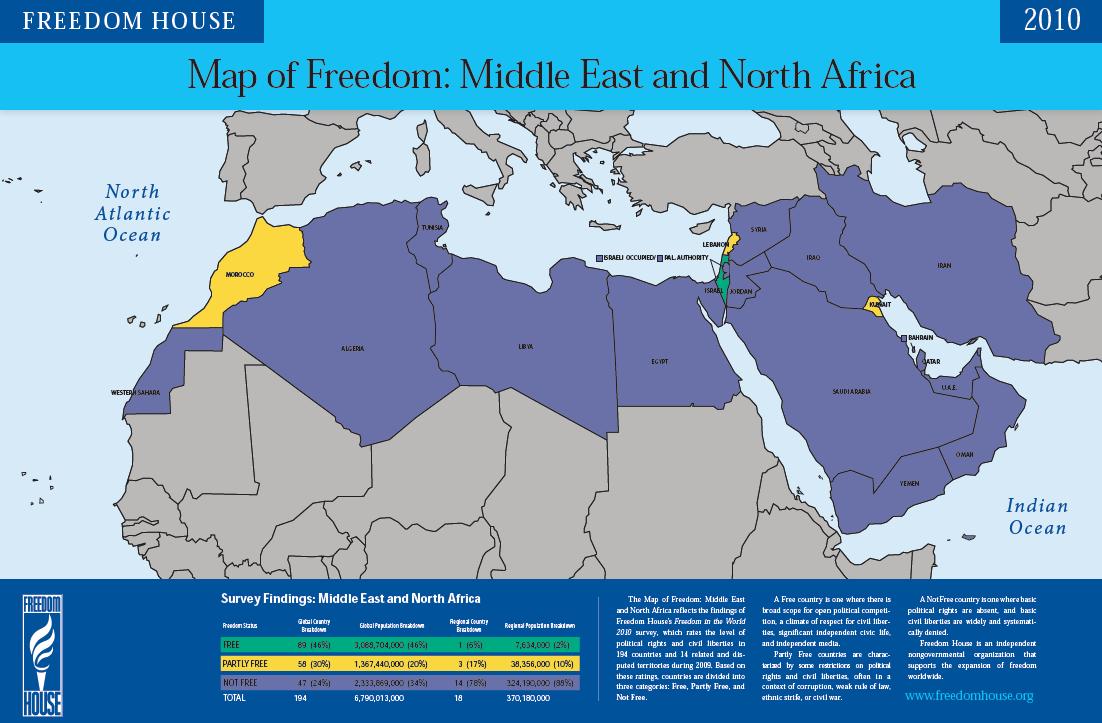
The birth of the roughly two dozen independent Arab countries after World War I ushered in an era of dictatorship that is unmatched in the modern world in terms of the complete abandonment of democratic elections. Every single Arab country had governments that routinely killed and tortured dissenters and repressed the vast majority of their population with an arsenal of atrocities that is not brought up in polite conversation.
The culture of violence that these dictatorships nurtured and supported is the true reason for any of the chaos on the streets today. Violent Arab protests against the U.S. have been a favorite tool of Arab dictators for decades, many of whom continue to use this Orwellian distraction to this day. However, we must remember that while the violence in the protests is deplorable and has no place in a democracy, anti-American sentiment is not a fatal democratic flaw.
This anti-American sentiment is largely the result of decades of the ex-dictatorships’ negative propaganda b. Moreover, the current ruling Islamist governments are finally running up against credible moderate voices. Instead of outright or implicit support for these demonstrations from every single Arab country, you have governments in each of the Arab Spring countries, Tunisia, Egypt, Libya, and Yemen, calling for calm.
The Arab world has many people who hate the United States and this is not going to change any time soon. When the Arab world chooses leadership for itself through elections, as they have done now in Tunisia, Egypt, and Libya, they will have the chance to vote for those who would be extremely violent just as Americans have the chance to vote for the Nazi party. A government that advocates violence is not even unusual for new democracies (See Native Americans or slavery in the U.S.) But in these Arab Spring countries what we have seen are peaceful elections and governments that are not war-hungry.
In Tunisia, the elected moderate President battles the Islamic hard-liners on an ongoing basis. In Egypt, even before the elections, the hard-line religious parties broke off from the more moderate and eventually victorious Muslim Brotherhood. In Libya, no one could have predicted how a population abused by Qaddafi for 40 years would vote. In the end, they also elected a moderate Islamic leadership.
The recently appointed Prime Minister of Libya was quick to respond to the violence at the U.S. embassy in Libya. He was quoted by CNN as saying, “At the beginning, I would like to send my sincere condolences to the families of the—of the ambassador and his companions, who were killed in the attack on the consulate yesterday. It is—has been a sad day for all of us here. This is a criminal act, acted by some individuals.” This is not exactly like a Qaddafi press release.
Even in Yemen, the poorest country in the Arab world with multiple ongoing ethnic, tribal, and Al Qaeda insurgencies, the dictator has resigned and given way to a moderate, although at this point unelected, leader with elections approaching. The millions of Yemenites who took to the streets time and time again to fell a dictator have been successful so far even though the future of their country is surely still in jeopardy.

And this is the case in each of the Arab Spring countries without exception. The future is uncertain, bouts of violence continue, governments still need massive reform and poverty is the norm. Extremist groups have found space to organize and dangerous underlying ethnic, religious, and secterian tensions still permeate all affairs of these new governments.
Yet, for those who cannot see past these troubles at the serious progress that has been made in less than two years, there is a reminder that stability in government is not the same as leaving one regime in power for decades using force, deception, and ruthlessness. It is, in fact, the complete opposite: Political stability in the modern world, of the type seen in Switzerland and Canada, can only come through the use of elections, albeit gradually and haltingly.
If Egypt’s dictator Mubarak had died several months before the Arab Spring there would have been complete chaos and the real potential of civil war. If the aging Oil King of Saudi Arabia slips in the bathroom tomorrow and breaks his neck there could be chaos. If Castro in Cuba dies tomorrow there could be chaos. If the secretly appointed new leader of China dies there could be chaos. This is not stability. The countries where dictatorships reign are the most unstable parts of the world, literally one life away from chaos and potentially serious violence. A country and a government need a plan that specifies who will be in charge and what to do when they don’t live forever.
Today, the Tunisian, Egyptian, and Libyan people have a plan for their next leaders because their people have set a time limit for leadership that ends with new elections. The plan for leadership in their countries is being set. This is more than can be said for the remaining dictatorships of the Arab world. There is no short-term fix to the problems of the world’s most violent region but certainly there is hope in the Arab Spring for malleable governments that are better prepared to deal with the issues ahead.
Across the democratic world of roughly three billion people, the political discussion, and media coverage of the Arab Spring has been atrocious, bordering on being anti-democracy in the Arab world. The democracy protests in Saudi Arabia and Bahrain are ignored, the Syria revolution is given little more than verbal support and the connection to the Russian and African democracy protests is unexplored. If the democracy-loving people of the world are not united behind these new democracies and we continue to follow our short-term interests over the cause of democracy, we will find that the next revolutions that will inevitably take place in the world of dictatorship may not bring such positive results.
Leave a Reply