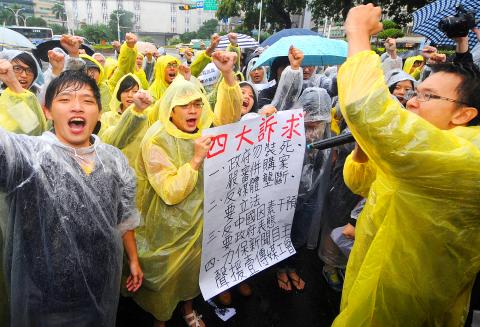
While the world’s second largest economy was going through a leadership change, across the strait in Taiwan, protests against a pro-China media monopoly have been an ongoing issue since July 2012. The main antagonists of this latest media takeover include the Youth Alliance Against Media Monsters, which consists mostly of students from local universities.
The protests began when rumors were confirmed that Hong Kong media mogul Jimmy Lai intended to sell the Taiwanese print and television branch of his company, Next Media. Avoiding coverage, the deal was signed in Macau on November 27, declaring the sale of the designated assets to a group of Taiwanese buyers for $601 million.
Led by Jeffrey Koo Jr., son of the chairman of one of Taiwan’s largest banks, Chinatrust Financial Holdings, these buyers count among them Tsai Shao-chung, President of Want Want Chinatimes Group, a major Taiwanese media group. Tsai’s father, Tsai Eng-meng, is the chairman of snack manufacturing group Want Want, and one of the wealthiest and most influential figures on the island. Together, they operate some of Taiwan’s most prominent media businesses, including the fourth biggest newspaper China Times, which is known for its pro-China stance.

The print business consists of the sensationalist newspaper Apple Daily, which boasts 40% of the market share. Unlike China Times or its pro-independence adversaries, Apple Daily is known for its bold and graphic take on crime and scandal regardless of their political shades, targeting the widest possible audience. From these perspectives, the newspaper holds a striking resemblance to its controversial UK counterpart, The Sun.
The planned takeover was officially announced on November 28 resulting in a fresh bout of outrage. From students and academics to journalist groups, many have gathered repeatedly to protest the deal under claims that it would give Tsai Eng-meng and the Want Want Chinatimes Group control of over 45% of Taiwan’s media outlets. In addition to the media monopoly, worries also center on Tsai’s blatantly pro-Beijing attitude and China’s potential influence on the independence of Taiwanese media. A number of Taiwanese students at universities across the globe, including Harvard University and UC Berkeley, have joined the lineup of protesters by taking group photos of themselves holding signs with anti-monopoly slogans, and spreading the photos throughout social media.
Rising Anxiety in Taiwan
The protests shed light on Taiwan’s sensitive position in relation to its colossal neighbor and the international community. In practice, this democratic republic has operated under its own independent government (the Republic of China) since 1949. However, pressure from China prevents Taiwan from openly declaring itself an independent country and obtaining recognition from other global powers. Due to Taiwan’s dependence on export and foreign trade, the nation has been compelled to cling on to the rise of the Chinese economy or face marginalization.
 Minor confrontations between students and local authorities have been featured heavily in local media throughout the past week. Among the hype surrounding the protests is the clash between Chen Wei-ting, student and co-convener of the Youth Alliance Against Media Monsters, and the Education Minister Chiang Wei-ling.
During a legislative committee on December 3, Chen, backed by legislators of the pro-independent Democratic Progressive Party (DPP), accused the minister of being a liar and a hypocrite for “feigning concern” about the protests and other student’s rights issues while only wanting to pacify matters and avoid trouble. However, Chen’s outburst has been condemned as brash and devoid of substance by a number of Taiwan’s prominent intelligentsia. Others consider him and his youth alliance yet another pawn in the political maneuvers of the DPP.
The deal has predictably also become one of many battlegrounds for the chronic conflict between pro-independence advocates and those favoring close relations or even future unification with China. Although the current ruling party is generally recognized as pro-China, a great number of Taiwanese view Taiwan as an independent country, especially the youth.
This has become increasingly so as many of the older generation, who had flocked to the island from the mainland along with the flee of the Chiang Kai-shek government in 1949, no longer constitute the backbone of Taiwan’s political and cultural arena. Their nostalgia and longing for a unified Chinese future has ceased to be a prominent voice in this rapidly changing society. New supporters of intimate relations with China are now usually those who are cultivating economic profits on the mainland.
Whether the protests will produce the desired results has yet to be observed. Whatever the outcome, they represent the fear Taiwan’s citizens harbor of losing their hard-earned media freedom, which once ranked among the best in Asia, as well as their anxiety over the slowly increasing influence of the superpower across the strait.
Leave a Reply