From Voice of America
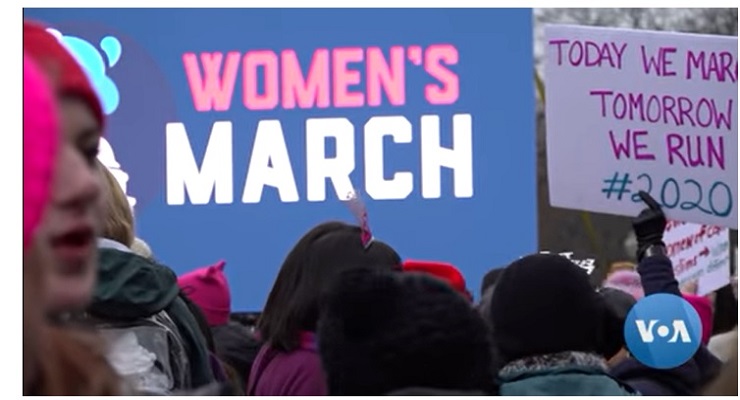
Thousands of women gathered in cities in the United States and around the world Saturday for the third annual Women’s March to demand gender equality and call attention to environmental concerns and immigrant rights, among other issues.
At a rally in Washington, just blocks from the White House, march organizer and transgender rights activist Abby Stein told demonstrators they would not be deterred by efforts to divide them.
“A lot of people out there, a lot of people in the media are trying to divide us. What brings us together is not the fact that we are all the same. What brings us together is our differences,” she said.
WATCH: Women’s March in Washington Brings Heat on a Wintry Day
House of the Lord Churches Executive Minister Leah Daughtry also addressed the Washington crowd, emphasizing the mantra “we can’t stop.”
“We won’t stop until every child is reunited with their parents at the border. We can’t stop. We can’t stop. We won’t stop until every child has free, full access to education. We can’t stop. We won’t stop until everyone has full, free, fair access to health care,” Daughtry said.
The beginning
The first Women’s March was held in 2017, the day after Donald Trump was sworn in as president of the United States.
On Trump’s first full day in office, hundreds of thousands of women descended on Washington in a display of popular opposition to the new administration and its policies. Sister marches were held in more than 600 locations in the U.S. and around the globe in solidarity with the marchers in Washington.
Peter Newsham, Washington’s interim police chief at the time, said of the march in the U.S. capital, “The crowd stretches so far that there’s no room left to march.”
Many marchers wore the knitted pink hats that have become a symbol of women’s anti-Trump sentiments.
Moment to movement
In 2018, organizers of the Women’s March sought to build on the first rally by focusing on politics and the power of women voters. They based the second march in Nevada, a battleground state for the midterm elections later in the year. The rally touting the message “Power to the Polls” focused on voter registration, featuring activists and members of Congress as speakers.
As in 2017, sister marches were held in cities across the U.S. and thousands of women also marched in London, Paris, Sydney and other European and Australian cities.
In 2019, the organizers brought the march back to Washington. Hopes were high for this year’s turnout, especially after a record 102 women were elected to the House of Representatives in the midterms at the end of last year.
A growing controversy
Several prominent women’s and civil rights organization were absent from the list of partners published on the Women’s March website.
Among those that had partnered with the group in the past, but missing in 2019, were civil rights organization Southern Poverty Law Center and the political action committee Emily’s List. By late Tuesday, the Democratic National Committee had also withdrawn its name from the list of partners.
The controversy surrounds several Women’s March leaders who have been accused of holding racist and anti-Semitic views.
Organizers have repeatedly denied all accusations of misconduct or using inappropriate speech.
The issue resurfaced when two of the march’s organizers appeared on the ABC talk show The View on Monday and refused to denounce Nation of Islam leader Louis Farrakhan, who has made repeated anti-Semitic and anti-white remarks.
When asked why she had posted a photo of Farrakhan on Instagram with a caption that included the hashtag for the title “Greatest of All Time,” Women’s March’s co-president Tamika Mallory said, “I didn’t call him the greatest of all time because of his rhetoric. I called him the greatest of all time because of what he’s done in black communities.”
Mallory’s co-president, Bob Bland, denied allegations printed in The New York Times and the Jewish magazine Tablet that members of the organization had expressed anti-Semitic beliefs at a meeting behind closed doors.
“The people that the journalist spoke to did not tell the truth, period, full stop,” Bland said. “The Women’s March unequivocally condemns anti-Semitism, bigotry, transphobia. … We condemn any statements of hate.”
Going forward
Some marchgoers said they weren’t deterred.
“The controversy has certainly influenced conversations around my decision to attend or not. Though it never was going to stop me, even more so I feel it’s important to attend,” said Naomi Zipursky of San Francisco, who was to attendthe local march there Saturday.
“By not showing up, I don’t even allow the conversation to begin and only create a bigger gap.
“The thought that I, as a Jewish woman, wouldn’t be welcome or would need to leave part of my identity at the door in order to attend the march is disheartening and, frankly, alienating,” Zipursky said. “[But] I also believe that what one person may say or do doesn’t necessarily represent what an entire organization may stand for.”
A separate “March for ALL Women” was planned for Saturday in the U.S. capital, with organizers rallying those who may feel the main march is divisive and not inclusive.
Many participants didn’t think the marches would ever compare to the first one.
“It’s going to be very hard to pull off the momentum of the first women’s march,” said Mary Tablante, communications officer at the Asian Americans Advancing Justice. “I am still going [this year] because I do think they are trying to improve it. There’s still a lot of work to be done in the movement.”
Despite the controversy, marches were planned in almost every U.S. state. ABC News reported some states would hold multiple marches: California planned to have more than 30 marches, New York 15, Texas, 13 and Florida 11. Michigan was to host eight and Pennsylvania seven.
Marches also were planned in more than a dozen European nations, as well as in Canada, Mexico, Australia, New Zealand, Indonesia, Pakistan, Israel, Nigeria, Uganda, Zambia and South Africa, among others.
Leave a Reply