The fourth in a series of seven posts on Electoral Strategy.
Now here is the hard part: What strategy might enhance the existing one but that also, of necessity, starts from the conditions at hand? Those familiar with this blog will not be surprised to hear that the grand inside/outside strategy —one focused on social transformation— seems a coherent approach that aims to improve political competition but also engages the lesser of two evils voters, the non-voters and the protest voters. Starting from where we stand is the beginning of strategy.
The inside/outside strategy, first and foremost, requires a shift in outlook and consciousness. The lesser of two evils, non-voters and protest voters need to start acting like we are all part of a movement. I realize this requires a lot of acting but the rightwing already sees us that way. And, we need to know that at no time in US history have significant oppositional movements been composed of people with a high level of ideological agreement.
Here we are: a movement with extremely diverse trends that is nonetheless capable of coordinated action — if not agreement on causes, ideas or ultimate solutions. We are capable of unity without uniformity. Act “as if” and maybe someday it will be so.
That elusive agreement is made all the more difficult by the fact that American social movements tend to be stridently moralistic, polemical and prone to sectarian division. In part, this is an inheritance from certain elements of our old but enduring religious culture. Now, we need an inclusive ecumenical approach.
 Or to borrow language from recent struggles over sexual and gender identity: The IOS is a transpartisan and polyamorous way to express love of politics.
There is no one road to revolution and no one revolution. We will have to agree to disagree. Polemic, ideological correctness, or class analysis will not build the ground on which unity will occur —at least ideological struggle has failed to do so for the last half-century or more. Unity is most likely to be found on the practical, strategic, truly political level of action. While ideas range widely without regard to real-world correlates, action reduces our options. In any one historical moment there is a limited range of action we can imagine as possible or experience as sustainable.
The vast majority of people in the social movements do agree on the need to create a more democratic system. But can we accept that to create such a system will require activism and action, courage and risk, all along the lines of the inside/outside continuum? Can people from as diverse positions as the labor lobbyist, the third party radical, out-and-out abstainer or local grassroots organizer find the hidden synergies between them?
Or more precisely can leaders sketch out a strategy to move us in this direction? Social movements have championed “diversity” but are we able to accept the tactical diversity within our own ranks? Can we turn our minds toward devising a strategy rather than simply supporting an issue, candidate or party?
Well it’s a long-shot but that is what social change is. If we continue to act in the same way what reasonable expectation do we have of a change in outcome?
In particular, the lesser of two evil activists and third party partisans can strengthen their hand by appreciating the latent power in all positions along the inside/outside spectrum. We need to convert that latent power into political leverage for our own position. Instead of static opposition between contending ideological positions we need the political skill to find practical political value in those positions we disagree with. Easier said than done but it starts by breaking the logjam.
Mobilize Non-Voters and Independents
Almost every successful popular movement in US history has won victories by bringing new constituencies to bear on the political process —to educate and mobilize people previously passive.
The non-voters hold the greatest potential power. Will chastising and blaming non-voters move them to act? The record suggests that the paternalistic approach: “I don’t want to hear you complain, if you don’t vote, ” is a failure. It is much more useful to see non-voting as a product of the system itself. To see non-voting as a strictly personal shortcoming is to let candidates off the hook for developing programs for the poor and political parties off the hook for organizing.
The tendency to blame the non-voter does not take into account how hard voting has become. Voter suppression laws raise the barrier particularly for poor and people of color. The states have a wide variety of prohibitions on voting for former convicts. Many are afraid to assert their rights even in states where registering to vote is allowed. Voter registration is now as important as it was during the civil rights movement.
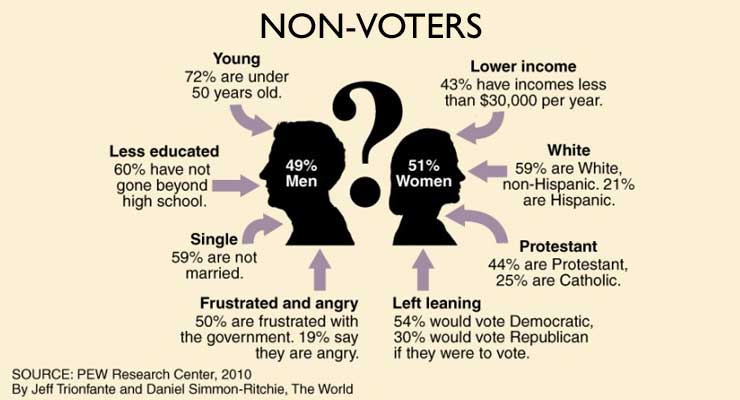
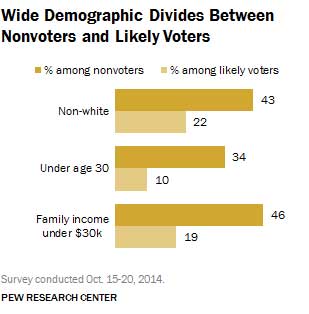
Massive voter registration counters the zero-sum assumption inherent in triangulation by acting on the obvious: with at least 40% of potential voters staying home the pie can be grown. 70 to 90 million votes are at stake. There are plenty of potential voters for progressive Democrats and Third parties alike.
There is no spoiler, just our failure to contest power.
Voter registration efforts are widely supported, at least in the abstract, but are often focused on the white and affluent people most likely to vote in predictable ways. Voter registration seem to pale in comparison with efforts to turn out the trusted vote. As a matter of redistributing power voter registration is a more important first step because it threatens the logic of triangulation by shifting the appeal to the poor, young, black, latin, asian and working class people that are the majority of non-voters and precisely the people that are the most oppressed and exploited by the existing system.
Many electoral activists treat the non-voters as pariah instead as sleeping giant. Yet research suggests that most non-voters are simply discouraged, too busy, working too hard or sidelined by the cumbersome and anti-democratic election procedures.
Voter registration is one of the first meaningful bargain chips we can develop given our current resources and practices. It’s just more of what we already do. Mainstream Democrats and Republicans will not like it. But, by investing serious resources in voter registration we can begin to become players not just supplicants.
Bringing millions of new voters to the ballot box is a powerful way of bargaining for candidates with better politics. Millions of new voters can only strengthen the progressive Democratic candidates and alternative parties.
We have plenty of demands to make if we have the courage to make them — but if those challenges do not have serious backing — then there is no compelling threat to mainstream or right-wing Democrats to move toward the people. And we are stuck with whining instead of winning.
Leave a Reply