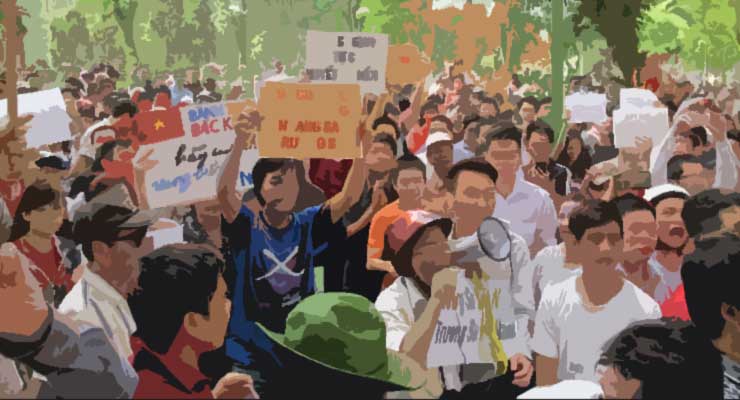

The spread of street protests in Vietnam this month shows a latent fear of China, worries about freedom of speech and distrust of the lawmaking process, analysts say.
Demonstrations with occasional violence reached 10 cities, including Vietnam’s largest, and attracted about 30,000 people June 9 and 10, London-based rights group Amnesty International said. Protests June 17 brought out thousands more.
At least 150 people were detained in the Communist country that frowns on dissent and police beat some demonstrators, according to Amnesty International. Eight people have been arrested, Vietnam’s Tuoi Tre newspaper reported.
Protesters throughout the country were responding to a National Assembly bill that would let foreign investors lease land up to 99 years in three special economic zones. They figured that investors from China, a political rival of Vietnam, would lease the land. Urban protesters also decried a cybersecurity law passed in the assembly June 12. The bill could lead to rules that let police monitor more closely what people post online.
“I think the underlying current of the protests is they don’t trust the government, and they don’t trust the National Assembly or they don’t trust the legislation,” said Trung Nguyen, international relations dean at Ho Chi Minh University of Social Sciences and Humanities.
Cybersecurity law
The assembly, Vietnam’s legislature, put off the 99-year lease bill until October for possible revisions. But protesters still fumed, as they do not know the October outcome. In the cities, protesters spoke out against the cybersecurity law as the specific rules on what’s permitted online will emerge only after about six months.
The law might let the government ask internet providers to share information about what common users say online, an Amnesty International official said. It might extend to people’s everyday gripes, said Adam McCarty, chief economist with Mekong Economics in the capital Hanoi.
“I think it’s purely political. They’ve always been monitoring blogs and some people have been arrested over the previous years,” he said. “But this one is a more obvious and blatant monitoring of everybody, even people not really actively trying to overthrow the government.”
In June 2017 the Ministry of Public Security proposed the Law on Cybersecurity to give it more power over prohibited content and anti-government activities. The assembly voted or 423-15, with 28 abstentions, in favor of it.
Second wave of protests
Protests surfaced June 17 in Ha Tinh province of central Vietnam, where thousands again opposed the cybersecurity law and the idea of leasing land to Chinese interests.
China makes up 6.8 percent of Vietnam’s foreign direct investment now, media reports say. The two sides fought a border war in the 1970s and today they vie for sovereignty over parts of the South China Sea.
About 200 were “detained, beaten and interrogated” in the financial center Ho Chi Minh City on Sunday, Catholic news website Ucanews.com reported.
The news website said tens of thousands of Catholics, including priests from Ha Tinh province, had attended “special masses” Sunday “to pray for justice and peace in the nation and for government leaders to protect the country.”
People at the rallies dispute the overall process for passage of new laws, Nguyen said.
“They think that there’s something wrong with the way the National Assembly is working,” Nguyen said. “They get instructions from the (ruling Communist Party’s) politburo and they are now working like a rubber stamp.”
In one province, Binh Thuan, protesters came with bricks and Molotov cocktails. They burned vehicles, injured police officers and damaged official buildings June 10 and 11, VietnamNet Bridge news website reported.
Vietnamese officials have accused extremists of inciting some of the protests. Communist Party General Secretary Nguyen Phu Trong appealed Sunday for calm.
Next moves
The sustained protests point to a “momentum,” said Ming Yu Hah, Amnesty International’s deputy regional director for Southeast Asia and the Pacific.
The demonstrations were “not planned,” she said, and questions about the outcome of the cybersecurity law remain on people’s minds.
“I think that these protests are of a pretty unique nature and that the momentum is continuing 10 days later, (and) we’re in a different digital environment, so I think there’s a lot of unknown factors that are definitely difficult to predict,” Hah said. Vietnam does not block websites, allowing people to mobilize via social media.
But as long as Vietnam’s economy keeps growing, raising people’s incomes through job creation, protests are unlikely to reach a tipping point, said Maxfield Brown, senior associate with the consultancy Dezan Shira & Associates in Ho Chi Minh City. The economy grew 6.8 percent last year.
“The location of the protests and the intensity of them suggest to me that it’s isolated groups of people who were already feeling disgruntled about something prior to (cybersecurity) becoming an issue,” he said.
Leave a Reply