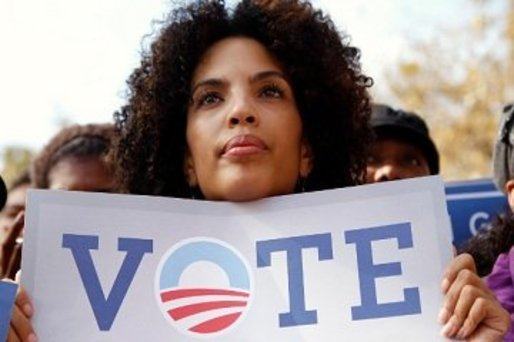
Supreme Court rules section of Voting Rights Act unconstitutional and deals new blow to democracy
A major decision by the Supreme Court has struck down part of the Voting Rights Act intended to protect minorities from local voting laws designed to prevent them from voting. This decision is considered a huge setback for America’s election system and will surely require the Congress to take action. According to the New York Times:
“The Supreme Court on Tuesday effectively struck down the heart of the Voting Rights Act of 1965 by a 5-to-4 vote, ruling that Congress had not provided adequate justification for subjecting nine states, mostly in the South, to federal oversight…
…The majority held that the coverage formula in Section 4 of the Voting Rights Act, originally passed in 1965 and most recently updated by Congress in 1975, was unconstitutional. The section determines which states must receive pre-clearance from federal authorities.”
Also, you can take a look at the actual decision in full text form or take a look at this excerpt from the dissenting opinion written by Justice Ginsburg that carried the intro, “JUSTICE GINSBURG, with whom JUSTICE BREYER, JUSTICE SOTOMAYOR, and JUSTICE KAGAN join, dissenting.”:
In the Court’s view, the very success of §5 of the Voting Rights Act demands its dormancy. Congress was of another mind. Recognizing that large progress has been made, Congress determined, based on a voluminous record, that the scourge of discrimination was not yet extirpated. The question this case presents is who decides whether, as currently operative, §5 remains justifiable,1 this Court, or a Congress charged with the obligation to enforce the post-Civil War Amendments “by appropriate legislation.” With overwhelming support in both Houses, Congress concluded that, for two prime reasons, §5 should continue in force, unabated. First, continuance would facilitate completion of the impressive gains thus far made; and second, continuance would guard against back sliding. Those assessments were well within Congress’ province to make and should elicit this Court’s unstinting approbation. I “[V]oting discrimination still exists; no one doubts that.” Ante, at 2. But the Court today terminates the remedy that proved to be best suited to block that discrimination.
The Voting Rights Act of 1965 (VRA) has worked to combat voting discrimination where other remedies had been tried and failed. Particularly effective is the VRA’s requirement of federal preclearance for all changes to voting laws in the regions of the country with the most aggravated records of rank discrimination against minority voting rights. A century after the Fourteenth and Fifteenth Amendments guaranteed citizens the right to vote free of discrimination on the basis of race, the “blight of racial discrimination in voting” continued to “infec[t] the electoral process in parts of our country.” South Carolina v. Katzenbach, 383 U. S. 301, 308 (1966). Early attempts to cope with this vile infection resembled battling the Hydra. Whenever one form of voting discrimination was identified and prohibited, others sprang up in its place. This Court repeatedly encountered the remarkable “variety and persistence” of laws disenfranchising minority citizens. Id., at 311. To take just one example, the Court, in 1927, held unconstitutional a Texas law barring black voters from participating in primary elections, Nixon v. Herndon, 273 U. S. 536, 541; in 1944, the Court struck down a “reenacted” and slightly altered version of the same law, Smith v. Allwright, 321 U. S. 649, 658; and in 1953, the Court once again confronted an attempt by Texas to “circumven[t]” the Fifteenth Amendment by adopting yet another variant of the all-white primary, Terry v. Adams, 345 U. S. 461, 469.
During this era, the Court recognized that discrimination against minority voters was a quintessentially political problem requiring a political solution. As Justice Holmes explained: If “the great mass of the white population intends to keep the blacks from voting,” “relief from [that] great political wrong, if done, as alleged, by the people of a State and the State itself, must be given by them or by the legislative and political department of the government of the United States.” Giles v. Harris, 189 U. S. 475, 488 (1903). Congress learned from experience that laws targeting particular electoral practices or enabling case-by-case litigation were inadequate to the task. In the Civil Rights Acts of 1957, 1960, and 1964, Congress authorized and then expanded the power of “the Attorney General to seek injunctions against public and private interference with the right to vote on racial grounds.” Katzenbach, 383 U. S., at 313. But circumstances reduced the ameliorative potential of these legislative Acts: “Voting suits are unusually onerous to prepare, some times requiring as many as 6,000 man-hours spent combing through registration records in preparation for trial. Litigation has been exceedingly slow, in part because of the ample opportunities for delay afforded voting officials and others involved in the proceed ings. Even when favorable decisions have finally been obtained, some of the States affected have merely switched to discriminatory devices not covered by the federal decrees or have enacted difficult new tests de signed to prolong the existing disparity between white and Negro registration.
Alternatively, certain local of ficials have defied and evaded court orders or have simply closed their registration offices to freeze the voting rolls.” Id., at 314 (footnote omitted). Patently, a new approach was needed. Answering that need, the Voting Rights Act became one of the most consequential, efficacious, and amply justified exercises of federal legislative power in our Nation’s his tory. Requiring federal preclearance of changes in voting laws in the covered jurisdictions—those States and locali ties where opposition to the Constitution’s commands were most virulent—the VRA provided a fit solution for minor ity voters as well as for States. Under the preclearance regime established by §5 of the VRA, covered jurisdictions must submit proposed changes in voting laws or proce dures to the Department of Justice (DOJ), which has 60 days to respond to the changes. 79 Stat. 439, codified at 42 U. S. C. §1973c(a). A change will be approved unless DOJ finds it has “the purpose [or] . . . the effect of denying or abridging the right to vote on account of race or color.” Ibid. In the alternative, the covered jurisdiction may seek approval by a three-judge District Court in the District of Columbia.
After a century’s failure to fulfill the promise of the Fourteenth and Fifteenth Amendments, passage of the VRA finally led to signal improvement on this front. “The Justice Department estimated that in the five years after [the VRA’s] passage, almost as many blacks registered [to vote] in Alabama, Mississippi, Georgia, Louisiana, North Carolina, and South Carolina as in the entire century before 1965.” Davidson, The Voting Rights Act: A Brief History, in Controversies in Minority Voting 7, 21 (B. Grofman & C. Davidson eds. 1992). And in assessing the overall effects of the VRA in 2006, Congress found that “[s]ignificant progress has been made in eliminating first generation barriers experienced by minority voters, in cluding increased numbers of registered minority voters, minority voter turnout, and minority representation in Congress, State legislatures, and local elected offices. This progress is the direct result of the Voting Rights Act of 1965.” Fannie Lou Hamer, Rosa Parks, and Coretta Scott King Voting Rights Act Reauthorization and Amendments Act of 2006 (hereinafter 2006 Reauthorization), §2(b)(1), 120 Stat. 577. On that matter of cause and effects there can be no genuine doubt.
Leave a Reply