Democracy, elections, and voting
It is increasingly likely the Supreme Court ruling on the controversial Voting Rights Act could further dismantle what is left. This latest update is from the Ballot Access News article, Is Voting Rights Act Section 2 in Constitutional Danger from the Supreme Court?, by American election expert Rick Hasen. It is increasingly likely the Supreme Court will further dismantle what is left of the Voting Rights Act. According to Hasen:
Will Baude raises the question in light of Shelby County. I address this issue briefly in my APSA paper, Shelby County and the Illusion of Minimalism. My bottom line is yes, Section 2 is in danger of being struck down as an unconstitutional exercise of congressional power under Shelby County. It was in danger before, and Shelby County moderately increases that danger. Unlike section 5, section 2 has no geographic or temporal limits, and further the majority might see it as not congruent and proportional to actual constitutional violations by states in crafting their district lines and other voting rules. I plan to write more on this in the future.
Also, from the Will Baude article:
There was a time when Section 2 was constitutionally controversial. The Court has said that the Constitution is only violated when a voting practice has a discriminatory intent, but Section 2 (which was enacted in its modern form in 1982) sweeps far more broadly, and many violations of Section 2 today are proved without a showing of discriminatory intent. This has led some to question whether Section 2 exceeds Congress’s enumerated powers or violates the 14th and 15th Amendments by effectively forcing legislatures to place too much weight on race in, for example, drawing district lines. Indeed, the Court has repeatedly construed Section 2 narrowly out of concerns about its constitutionality (e.g., in Bartlett v. Strickland; Miller v. Johnson, and various opinions in LULAC v. Perry). These views are also discussed (and criticized) by Chris Elmendorf and Luis Fuentes-Rohwer…
…I could see this going either way. On one hand, Shelby County demonstrates a willingness to strike down pieces of the Voting Rights Act as exceeding Congress’s powers and some of the rhetoric could certainly be put to good use in a challenge to Section 2. On the other hand, as a practical matter the Court might not be willing to strike down both operative pieces of the statute. And one of Justice Kennedy’s complaints in the past has been about the conflict he sees between Section 2 and Section 5 – see his concurring opinion in Georgia v. Ashcroft, which was quoted in Northwest Austin. If Section 5 ends up gone or totally transformed, there’s no conflict anymore and that may alleviate some of his concerns about Section 2. If Shelby County ends up saving Section 2, it would be an interesting irony.
About the Voting Rights Act:
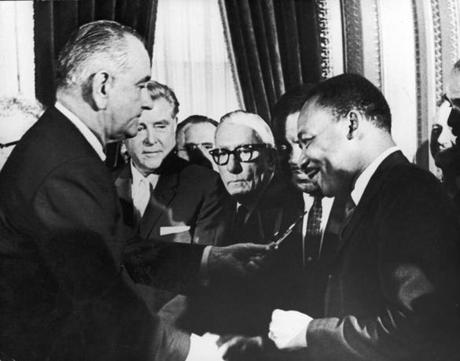
The Voting Rights Act of 1965 is a landmark piece of national legislation in the United States that prohibits discrimination in voting. Echoing the language of the 15th Amendment, the Act prohibits states and local governments from imposing any “voting qualification or prerequisite to voting, or standard, practice, or procedure … to deny or abridge the right of any citizen of the United States to vote on account of race or color.” Specifically, Congress intended the Act to outlaw the practice of requiring otherwise qualified voters to pass literacy tests in order to register to vote, a principal means by which Southern states had prevented African Americans from exercising the franchise. The Act was signed into law by President Lyndon B. Johnson, who had earlier signed the landmark Civil Rights Act of 1964 into law.
Frank Henry says
The VRA (1965 and revisions) is/was a small step forward that gave only some
voters a small portion of their “Full Voting Rights”… Now is a good time to
up-grade the VRA to include and define all the components of ALL voters’ “Full
Voting Rights”.
It can be done….lets do it. Thanks and Good Luck.
Frank Henry; Tel: 928-649-0249