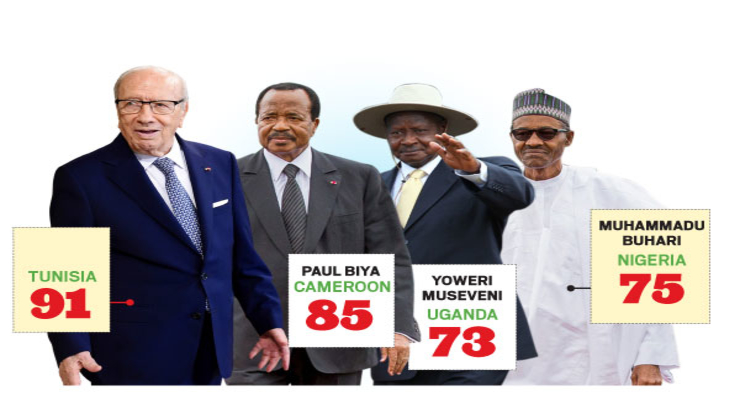
African Heads of State, who are currently all male, have an average age of 64.32 years. This situation appears to be at odds with the demographics in Africa as the continent’s population is youthful.
At 91, Beji Caid Essebsi of Tunisia is the oldest President on the continent. He is followed by Cameroon Republic’s President Paul Biya, 85; Algeria’s Abdelaziz Bouteflika, 81, and; Alpha Condé of Guinea-Conakry, 80. 16 African Heads of State are in their 70s, 15 in their 60s, and 20 in their 50s. Joseph Kabila of the Democratic Republic of Congo (DRC) is 47 years old. At 41, Abiy Ahmed Ali, Ethiopia’s new Prime Minister is Africa’s youngest ruler.
Africa’s non-monarchical rulers who have been in power for 19 or more years are between the ages of 66 and 85. Teodoro Obiang Nguema Mbasogo of Equatorial Guinea has been in power since 1979, that is 39 years. He is 76 years old. Paul Biya of Cameroon Republic came to power by constitutional appointment in November 1982. At 85 he is Africa’s second longest ruler with 35 years in power. Museveni of Uganda has been in power since 1986, he is 73 years old while Omar al-Bashir of Sudan, 74, came to power in 1989. Isaias Afwerki has been Eritrea’s only ruler since the country’s independence in 1991. At 72, and 27 years in power, he is still to organise democratic elections. Denis Sassou Nguesso, 74, first ruled the Republic of Congo (Brazzaville) from 1979 to 1992 as a military dictator. He returned to power by means of a rebellion in 1997. He therefore totals 34 years as Head of State. Abdelaziz Bouteflika of Algeria the 81-year-old ailing President of Algeria came to power in 1999. Ismaïl Omar Guelleh of Djibouti, 70, also came to power that same year.
At 66, Idris Deby Itno of Chad who seized power in 1990 by means of a coup is the youngest of these long-stay non-monarchs in Africa. In May 2018, he promulgated a “…new constitution [that reimposed] a two-term limit scrapped in a 2005 referendum. But it will not be applied retroactively, meaning Deby could serve two terms after the next election in 2021.” Like Idriss Deby, a good number of Africa’s oldest rulers have fiddled with the Constitution of their respective countries in order to remain in power.
Table: List of Africa’s 57 Heads of State and their ages
Africa counts 54 independent and recognised States. Western Sahara is still battling for recognition while Somaliland intends to affirm its independence from Somalia and gain recognition. Its neighbour, “…Puntland says it does not seek recognition as an independent entity, wishing instead to be part of a federal Somalia”. While Somaliland, Western Sahara, and Puntland are widely known there are other no less notorious territories equally vying for autonomy or full independence. Angola’s Cabinda, Ambazonia which is the successor State of the British Southern Cameroons, and Nigeria’s Biafra are some of such territories.
| Country | Political status | President | Gender | Date of Birth | Age | In office since |
| Algeria | Independent and recognised. | Abdelaziz Bouteflika | Male | 2 March 1937 | 81 | 1999 |
| Angola | Independent and recognised. | João Manuel Gonçalves Lourenço | Male | 5 March 1954 | 64 | 2017 |
| Benin | Independent and recognised. | Patrice Talon | Male | 1 May 1958 | 60 | 2016 |
| Botswana | Independent and recognised. | Mokgweetsi Masisi | Male | 21 July 1962 | 56 | 2018 |
| Burkina Faso | Independent and recognised. | Roch Marc Christian Kaboré | Male | 25 April 1957 | 61 | 2015 |
| Burundi | Independent and recognised. | Pierre Nkurunziza | Male | 19 December 1964 | 53 | 2005 |
| Cameroon Republic | Independent and recognised. | Paul Bartholomew Biya’a Mbi Mvondo | Male
|
13 February 1933 | 85 | 1982 |
| Cape Verde | Independent and recognised. | Jorge Carlos Fonseca | Male | 20 October 1950 | 67 | 2011 |
| Central African Republic (CAR) | Independent and recognised. | Faustin Archange Touadera | Male | 21 April 1957 | 61 | 2016 |
| Chad | Independent and recognised. | Idriss Deby Itno | Male | 18 June 1952 | 66 | 1990 |
| Comoros | Independent and recognised. | Azali Assoumani, | Male | 31 December 1959 | 58 | 2016 |
| Congo-Brazzaville | Independent and recognised. | Denis Sassou Nguesso | Male | 23 November 1943 | 74 | 1997 |
| Democratic Republic Congo (DRC) | Independent and recognised. | Joseph Kabila | Male | 4 June 1971 | 47 | 2001 |
| Djibouti | Independent and recognised. | Ismaïl Omar Guelleh | Male | 27 November 1947 | 70 | 1999 |
| Egypt | Independent and recognised. | Abdel Fattah el-Sisi | Male | 19 November 1954 | 63 | 2014 |
| Equatorial Guinea | Independent and recognised. | Teodoro Obiang Nguema Mbasogo, | Male | 5 June 1942 | 76 | 1979 |
| Eritrea | Independent and recognised. | Isaias Afwerki | Male | 2 February 1946 | 72 | 1991 |
| Ethiopia | Independent and recognised. | Abiy Ahmed Ali | Male | 15 August 1976 | 41 | 2018 |
| Gabon | Independent and recognised. | Ali Bongo Ondimba | Male | 9 February 1959 | 59 | 2009 |
| Gambia, the | Independent and recognised. | Adama Barrow | Male | 11 February 1965 | 53 | 2017 |
| Ghana | Independent and recognised. | Nana Akufo-Addo | Male | 29 March 1944 | 74 | 2017 |
| Guinea | Independent and recognised. | Alpha Condé | Male | 4 March 1938 | 80 | 2010 |
| Guinea-Bissau | Independent and recognised. | José Mario Vaz | Male | 10 December 1957 | 60 | 2014 |
| Ivory Coast | Independent and recognised. | Alassane Dramane Ouattara | Male | 1 January 1942 | 76 | 2014 |
| Kenya | Independent and recognised. | Uhuru Kenyatta | Male | 26 October 1961 | 56 | 2013 |
| Lesotho | Independent and recognised. | King Letsie III | Male | 17 July 1963 | 55 | 1997 |
| Liberia | Independent and recognised. | George Tawlon Manneh Oppong Ousman Weah | Male | 1 October 1966 | 51 | 2018 |
| Libya | Independent and recognised. | Fayez al-Sarraj, Chairman of the Presidential Council of Libya, co-claimant and also holds position of Premier | Male | 20 February 1960 | 58 | 2016 |
| Madagascar | Independent and recognised. | Hery Rajaonarimampianina | Male | 6 November 1958 | 59 | 2014 |
| Malawi | Independent and recognised. | Peter Mutharika | Male | 18 July 1940 | 78 | 2014 |
| Mali | Independent and recognised. | Ibrahim Boubacar Keïta | Male | 29 January 1945 | 73 | 2013 |
| Mauritania | Independent and recognised. | Mohamed Ould Abdel Aziz | Male | 20 December 1956 | 61 | 2009 |
| Mauritius | Independent and recognised. | Barlen Vyapoory (Acting) | Male | 1945/46 | 72 | 2018 |
| Morocco | Independent and recognised. | Mohammed VI | Male | 21 August 1963 | 54 | 1999 |
| Mozambique | Independent and recognised. | Filipe Nyusi | Male | 9 February 1959 | 59 | 2015 |
| Namibia | Independent and recognised. | Hage Geingob | Male | 3 August 1941 | 76 | 2015 |
| Niger | Independent and recognised. | Mahamadou Issoufou | Male | 1 January 1951 | 67 | 2011 |
| Nigeria | Independent and recognised. | Muhammadu Buhari | Male | 17 December 1942 | 75 | 2015 |
| Puntland | Self-declared autonomous State. | Abdiweli Mohamed Ali | Male | 2 July 1965 | 53 | 2014 |
| Rwanda | Independent and recognised. | Paul Kagame | Male | 23 October 1957 | 60 | 2000 |
| Sao Tome and Principe | Independent and recognised. | Evaristo Carvalho | Male | 22 October 1941 | 76 | 2016 |
| Senegal | Independent and recognised. | Macky Sall | Male | 11 December 1961 | 56 | 2012 |
| Seychelles | Independent and recognised. | Danny Faure | Male | 8 May 1962 | 56 | 2016 |
| Sierra Leone | Independent and recognised. | Julius Maada Bio | Male | 12 May 1964 | 54 | 2018 |
| Somalia | Independent and recognised. | Mohamed Abdullahi Mohamed | Male | 11 March 1962 | 56 | 2017 |
| Somaliland | Unrecognised, secessionist state | Muse Bihi Abdi | Male | 1948 | 70 | 2017 |
| South Africa | Independent and recognised. | Cyril Ramaphosa | Male | 17 November 1952 | 65 | 2018 |
| South Sudan | Independent and recognised. | Salva Kiir Mayardit | Male | 13 September 1951 | 66 | 2005 |
| Sudan | Independent and recognised. | Omar al-Bashir | Male | 1 January 1944 | 74 | 1989 |
| Swaziland | Independent and recognised. | King Mswati III | Male | 19 April 1968 | 50 | 1986 |
| Tanzania | Independent and recognised. | John Magufuli | Male | 29 October 1959 | 58 | 2015 |
| Togo | Independent and recognised. | Faure Gnassingbé | Male | 6 June 1966 | 52 | 2005 |
| Tunisia | Independent and recognised. | Beji Caid Essebsi | Male | 29 November 1926 | 91 | 2014 |
| Uganda | Independent and recognised. | Yoweri Kaguta Museveni | Male | 15 August 1944 | 73 | 1986 |
| Western Sahara | Self-declared, partially recognised State | Brahim Ghali | Male | 16 September 1949 | 69 | 2016 |
| Zambia | Independent and recognised. | Edgar Lungu | Male | 11 November 1956 | 61 | 2015 |
| Zimbabwe | Independent and recognised. | Emmerson Mnangagwa | Male | 15 September 1942 | 75 | 2017 |
Table last updated on 30 July 2018
David Anderson says
Great article and table. While ages, and length of time in power are well reported, the phenomenon of old leaders clinging to power being a particular African problem is rarely reported *together*.
The real danger of course is in dynasties as they ready their idiot sons to run the show, a surprisingly common occurrence as you’ll be aware.
I wrote about these matters myself in a Zimbabwean context last year
https://www.forbes.com/sites/realspin/2017/05/09/what-next-for-a-zimbabwe-shaped-hole-in-africa/2
Well done Ngah,
David
Ngah Gabriel says
Thanks Mr. Anderson. I agree that more reports have to done on the specific particularity you have singled out, notably from a comparative angle. Indeed, dynastic rule is what these bastards ruling our continent dream of. In Cameroon, the main school training senior civil servants is filled with kids of the idiots in power. That way they recycle their kakistocracy. In your article in forbes.com, you made a powerful point on the damages to leadership that long-stay in power does to any nation. I agree with your arguments. You gave facts.