Table-top and computer games are a great way to bring academic subjects to life. You see this mostly in historical games, often about wars, e.g. the Soviet-Finnish Winter War. There are also games about economics and politics, including that most glorious of political games, Die Macher, BoardGameGeek’s very first entry.
It also works the other way around—a good subject/theme brings otherwise dry mechanics to life. The ideal game combines an engaging theme with clever game mechanics.
Some of these games are realistic enough to be called simulations, and the results can be of research interest. For example, EdTech startup MobLab provides online economics games for educational purposes, but data from their Competitive Market Game was used in a research paper to demonstrate how, across nations and cultures, supply and demand rapidly converge.
So how about voting theory? Voting theory is abstract: hard to teach, and hard to make feel relevant. In commercial and social settings we make generally good group decisions naturally, but in politics we seem stuck in a two-year cycle of conflict and suboptimal decisions. Throughout US history elections have suffered from vote splitting, e.g. the infamous spoiler effect, as described in William Poundstone’s book Gaming the Vote.
There are alternative voting methods that produce better results, e.g., Score Voting, Approval Voting, STAR Voting, Condorcet methods, and Instant Runoff Voting. However, proponents of various methods seem fanatical about their favorites, and keep bickering and talking past one another. We need some experimentation.
Could we create a coopetitive game where players 1) choose their voting method and 2) vote, in order to 1) maximize their team score against other teams and 2) maximize their individual score within a team, given some economic constraints (e.g. time)?
Concurrence
Concurrence is a simple voting game using an ordinary deck of cards. Suits represent campaign issues or candidate traits, and ranks represent a position on an issue. Players are divided into teams, and each team agrees on a voting method. Each round, cards are dealt to every player-voter and non-player candidate. Players prefer candidates whose cards are closest to their own, and vote silently, within a time limit. A player’s score is the difference between their hand and the winning candidate’s hand. The team score is the average of its players’ scores. The winner is the player with the lowest score on the lowest-scoring team. This is an overview, but I’ll provide details below.
With repeated play, two things should become clear: which team has the better voting method, and which team best uses it. There’s no use in having a sophisticated voting method if a group cannot use it quickly and accurately.
Concurrence is a bit mentally taxing to play for long, and it would benefit from a themed deck. However, it also provides a voting mechanic that can be used in other tabletop games. You can find more details and suggested variations here. The name Concurrence is a play on words: it means “agreement” in English and “competition” in Russian.
Basic rules:
Background
- Suits are campaign issues.
- Ranks are linear positions on issues.
- A hand of cards is a position or preference in issue-space.
- Ranks are additive, so the position of a hand with two cards of the same suit is the sum of their ranks.
- The absence of a suit (void) is treated as 0 for a candidate, and null (don’t care) for a player.
- The mathematical difference between two hands is their difference on the issues.
Goal: Elect a candidate hand that minimizes your score (the difference between your hand and that of the winning candidate).
Materials
- Decks of cards (for simplicity, you may remove the face cards)
- Ballots (e.g. laminated paper with dry or wet-erase markers)
- Score sheets and pens
Setup
- Divide players into roughly equal-size teams. There should be 2–8 players per team, and 2–8 teams.
Play
Each team agrees (unanimously) on a voting method (including a tie-breaking method), and prepares its ballots. Ballots could be anything (e.g. paper or fingers), but the votes must be cast secretly and securely. A mature team will likely choose a default voting method, and change it rarely.
When every team is ready
- Deal 2 cards face down to each player, and 3 cards face up in the middle for each of 3 candidates.
- Players vote silently.
- Votes are tabulated, and a winning candidate is determined.
- If a team’s voting and tabulation take longer than 60 seconds, another team may choose the winning candidate.
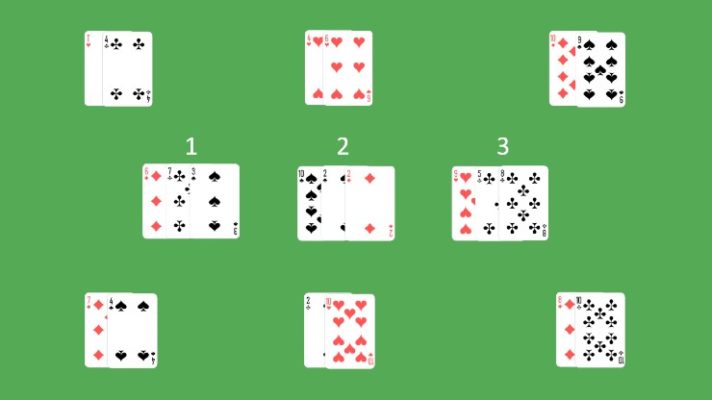
Scoring
- Individual scores are the absolute difference between player hand and that of the winning candidate, on the issues (suits) that the player cares about.
- Team scores are the average of the individual scores (in case teams are of different sizes).
- The winner is the lowest-scoring player in the lowest-scoring team.
Repeat the play procedure for an agreed number of rounds (say 20) or number of points (say 200).
Leave a Reply