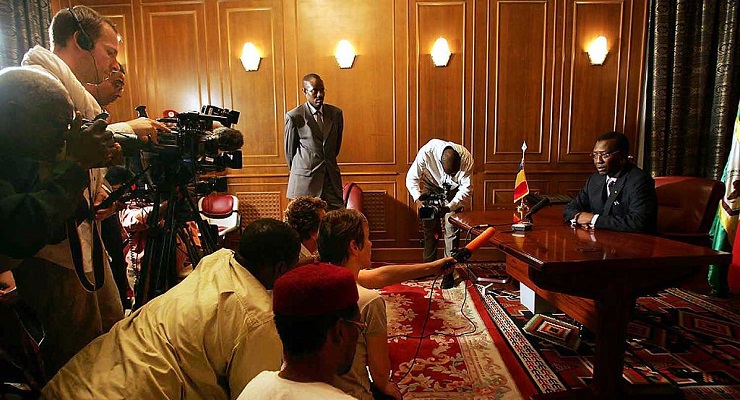

Chadian President Idriss Deby has died on the frontline, the army announced today. The army spokesman said he died from injuries sustained from military combat against rebels in the north. A coup d’état took place immediately. According to the British Broadcasting Corporation (BBC):
On Monday, provisional results from the election on 11 April projected he would win a sixth term in office, with 80% of the vote. The government and parliament have been dissolved. A military council will govern for the next 18 months. Mr. Déby, 68, was one of Africa’s longest-serving leaders. He first came to power in an armed uprising in 1990.
Chad got its independence from French colonial rule on 11 August 1960. Its first President was François Tombalbaye who took over leadership of the Chadian Progressive Party (PPT) from Gabriel Francisco Lisette in 1959.
In 1962 Tombalbaye banned all political parties and imposed the PPT as the only party in the country. A southerner, he discriminated against central and northern Chadians. The anger transformed to a revolt against taxation on 01 November 1965 in Guéra Préfecture with a death toll of 500. This incident contributed to the creation of a rebellion in Sudan of the rebel movement, the National Liberation Movement of Chad (FROLINAT) that aimed to unseat Tombalbaye and end southern domination.
French support had very little impact in quelling the rebellion. Tombalbaye then turned to Libya. Gadhafi’s help proved useful as Tombalbaye registered several successes in undermining the capabilities of the FROLINAT through cutting the rebellion’s supplies. However, Tombalbayé grew increasingly paranoid and finally lost support from the southerners who dominated both the administration and the army.
Having engaged in a military purge of dissatisfied soldiers, Tombalbaye detained the Army Commander General Felix Malloum in July 1973 then pursued his purge with the arrest of commanders of the gendarmerie, triggering the coup of 13 April 1975. As gendarmes engaged the Presidential Guard, Gen. Noel Odingar arrived with reinforcements and took over the leadership of the coup. Odingar originally assumed the position of Head of State. However, once the Supreme Military Council was formed on 15 April 1975 he handed over power to a freed Brigadier General Félix Malloum.
Politically, Chad has been heavily involved in regional and continental crises. Consequently, the country is rated as not free and a violator of human rights and has also suffered from dictatorships. “On May 30, 2016, former Chadian dictator Hissène Habré was convicted of crimes against humanity, war crimes, and torture, including sexual violence and rape, by the Extraordinary African Chambers in the Senegalese court system and sentenced to life in prison. “On April 27, 2017, an appeals court confirmed the verdict and ordered Habré to pay approximately 123 million euros in victim compensation.”
Hissène Habré had become Prime Minister under General Félix Malloum but lost that position once Goukouni Oueddei came to power through elections in 1979. Habré went into exile to Sudan with his Armed Forces of the North (FAN). On 07 June 1982, his rebellion succeeded to topple the Oueddei Government. Habré then became President until 1992 when he was in turn ousted by Idriss Deby.
According to Action against Hunger:
Ethnic rivalry within the government eventually led to Habre’s downfall. In 1989, Idriss Deby, one of Habre’s leading generals from eastern Chad, fled to Darfur, Sudan, where he staged a series of attacks on Habre. In December 1990, Deby and the Patriotic Salvation Movement (MPS), with assistance from Libya, gained control of the Chadian government.
When Hissène Habré took power one of his allies was Idris Deby, a seasoned military officer and war tactician. Deby who backed the Malloum regime eventually tied his fortunes Habré. After Habré seized power in 1982 he made Deby his army chief the following year. Deby skillfully led Habré’s internal and external wars. However, a rift grew between the two warlords when Habré’s ethnic purges affected Deby’s Zaghawa ethnic group. Habré then attempted to purge even close allies from the Zaghawa including Déby, Mahamat Itno, the minister of interior, and Hassan Djamous, commander in chief of the Chadian army, accusing them of preparing a coup d’état. Déby first fled to Darfur, and then to Libya, where Gaddhafi welcomed him. In the meantime, Itno and Djamous were arrested and killed. Thereafter, Habré intensified his purge of the Zaghawa.
As Habré intensified the killings of the Zaghawa, Déby moved to Sudan and formed the Patriotic Salvation Movement (MPS), an insurgent group. With support from Libya and Sudan, Idriss launched attacks against Habré in October 1989. After a decisive attack launched on 10 November 1990 and on 2 December Déby’s seized N’Djaména.
Leave a Reply