Perhaps the most important core tenant of Enlightenment thinking was the belief in individualism – a refocus from obedience to traditional authority and societal conformity into a belief in the rational capabilities of individuals who were born with inalienable rights and the power of rational thought, with average citizens being able to use reason to figure out their own opinions about the world around them.
It is also a true marvel to note how in the history of ideas unexpected connections crop up. There is in this case a line of connection through brilliant thought experiments that built a case for the capacity for individual reason in people that stems from medieval Islamic Central Asia and Spain, through the European Enlightenment and to our Thomas Paine.
_CIPB2067.jpg)
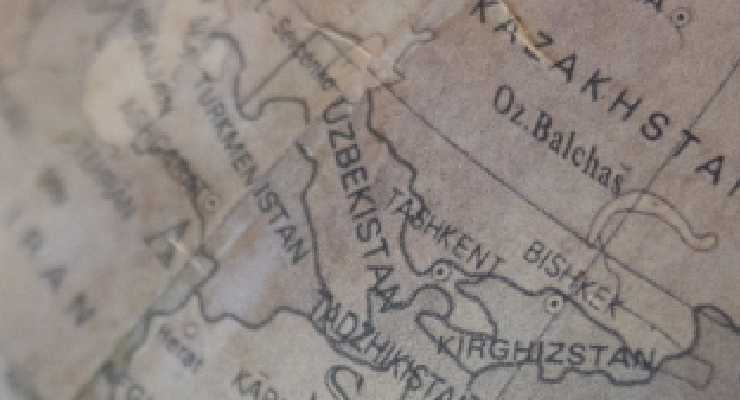
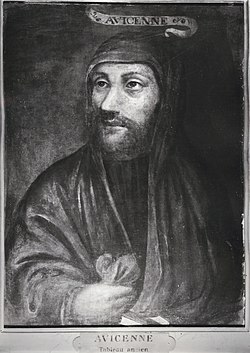
The thread of thought experiments starts with philosopher Ibn Sina, referred to as Avicenna in the West, who is often referred to as the “father of early modern medicine”. He was born in 980 in the Samanid Empire in today’s Uzbekistan. A true polymath, Ibn Sina made major contributions in astronomy, chemistry, geography, geology, logic, mathematics, physics, psychology, Islamic theology, and poetry. One of Ibn Sina’s contributions to human knowledge was a thought experiment he proposed called the “Floating Man”.
The basic concept is that of a falling or floating man who spontaneously comes into existence suspended in the air without the ability to touch, see, or even perceive any of his surroundings yet still has the complete ability to think for himself. Ibn Sina was concerned mainly with how the thought experiment brought to light questions about the separation of soul and body. In this thought experiment, we can see obvious foreshadowing of two Enlightenment philosophers Rene Descartes and his famous phrase “Cogito ergo sum” or “I think, therefore I am” and also John Locke and Jean Jaques Rousseau’s belief in an idea first proposed by the Ancient Greek philosopher Aristotle called “tabula rasa” – the idea that the human mind was a blank slate at birth.
The essence of tabula rasa and Ibn Sina’s Floating Man was to explore the power of the individual mind without taking into account external interference. For Ibn Sina, the thought experiment revealed that people can be self aware and are endowed with a working mind without the need of society, authority or even their own senses to understand their existence, thus revealing the separation of mind and body.
Ibn Sina’s thought experiment had a direct impact on Arab Andalusian Muslim polymath, Abu Bakr Muhammad ibn Tufayl, born in 1105, who was an immensely influential vizier, philosopher, astronomer, physician, and early supporter of dissection and autopsy. Ibn Tufayl wrote what is considered the first philosophical novel titled Ḥayy ibn Yaqẓān translated in Europe as either The Self-Taught Philosopher or The Improvement of Human Reason: Exhibited in the Life of Hai Ebn Yokdhan. In this work, Ibn Tufayl proposes his own thought experiment inspired and even named after the work of Ibn Sina.
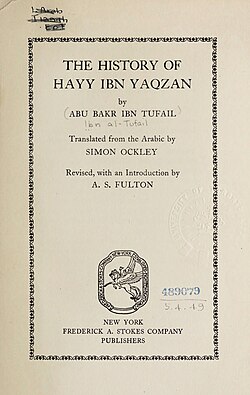

The plot of the novel is a story about a boy who grows up without connection to humans. Raised by an antelope on an isolated island, he learns only the languages of the antelope, birds, and other animals and survives by imitating animals and making shoes and clothes from their skins. As he gets older, he reaches higher, even unprecedented levels of knowledge of astronomy, biology, philosophy, and (important to Ibn Tufayl) religion where he investigates the origin of the universe through meditation and intuition while isolated from other humans. He is eventually introduced to human society and becomes an influential teacher although he finds resistance from those who he finds have been indoctrinated by custom. The protagonist concludes that individuals can find wisdom without teaching, religion and revelation.
The impact of the writing cannot be understated, influencing Islamic, Jewish and Christian scholarship and considered a monumental Sufi text in the Muslim world. According to the article “Desert island scripts” published in March 22, 2003 in The Guardian, it is the most translated Arabic language text in history after the Quran and the One Thousand and One Nights. The novel was immensely influential in spreading the idea of individualism – that the power of ideas didn’t have to flow from authority. Where Ibn Sina focused his thought experiment on sensory deprivation, Ibn Tufayl took the concept to its next step: social isolation.
According to G. A. Russell’s 1994 book, The ‘Arabick’ Interest of the Natural Philosophers in Seventeenth-Century England, the book was a best-seller in the Enlightenment after it was rediscovered through translation into European languages. Ibn Tufayl and his close acquaintance, Abul-Walid Muhammad Ibn Rushd, another Muslim polymath known as the ‘Father of Rationalism’ in Europe, made translations of Greek and Roman texts that were widely shared among thinkers as diverse as Isaac Newton, Thomas Hobbes, John Locke, Christiaan Huygens, Gottfried Wilhelm Leibniz, Immanuel Kant, David Hume John Milton, John Stuart Mill and even later philosophers like Karl Marx.
It is through this connection to Ibn Sina and Ibn Tafayl that these great Muslim philosophers indirectly influenced the Enlightenment’s greatest political scientist, Thomas Paine. Paine was well read in early Enlightenment thinking and was heavily influenced by John Locke, who himself was well read in Islamic thought and owned a copy of the Koran. Locke was close friends with Edward Pococke the Younger who first translated Ibn Tafayl’s novel Ḥayy ibn Yaqẓān into English. According to G. A. Russell:
‘On the basis of all of the evidence, the conclusion is inescapable that not only Locke must have known the work, but also that he must have been intimately acquainted with the progress of the whole project. Thus the period (1667–1671), during which Locke first began to consider the “problems” of the Essay, and put them in writing for the first time, coincide precisely with that of the translation, publication and dissemination of the Philosophus autodidactus by Edward and Dr. Pococke’
Another major influence on Paine was Jean-Jaques Rousseau who wrote the popular treatise “Èmile or Treatise on Education”, a monumental work that seeks to reexamine ideal education from birth to adolescence. According to Mustafa Önder in his essay titled “J. J. Rousseau, Èmile and Religious Education”, published in the Universal Journal of Educational Research, it is “highly probable that Rousseau has seen and read “Hayy Ibn Yaqzan” before his work on ‘Èmile’ and Rousseau’s other essay ‘The Social Contract’. Beginning with the famous line, “man is born free, but everywhere he is in chains”, ‘Èmile’ is a call to encourage individualism when educating citizens and was a major influence during the French Revolution.
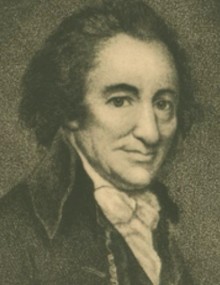
Paine was also likely exposed to Ibn Tafayl’s work through his family, his father was a Quaker, a Protestant sect that was heavily influenced by Ibn Tufayl’s humanist theology that found that all people were equally important to protect regardless of faith, gender or race. One of the leading proponents of Quaker theology was Robert Barclay, born in 1648 in Scotland, who argued that all people can be illuminated by what he called the “Inward Light of Christ”. According to the essay “Andalusian Mysticism and Liberal Quakerism?: Bringing Hayy ibn Yaqzan and Rufus Jones into Dialogue” published in the 2014 American Academy of Religion Annual Meeting by David E Russell and Christy Randazzo:
Hayy ibn Yaqzan is referenced in Robert Barclay’s Theses Theologicae, indicating that the 12th century philosophical novel was known by early Quaker theologians and leaders. Barclay’s Apology, in its early editions, makes a reference to “an account of one Hai Ebn Yokdan; who, without converse of man, living in an island alone, attained to such a profound Knowledge, as to have immediate converse with [God].”
It is through Paine where Ibn Sina and Ibn Tafayl’s thought experiments had their most enduring impact upon the most influential political thought experiment of modern representative democracy and the culmination of turning the Enlightenment’s political science into practical reality. In his 1776 pamphlet Common Sense, Paine’s own thought experiment begins with the following words:
In order to gain a clear and just idea of the design and end of government, let us suppose a small number of persons settled in some sequestered part of the earth, unconnected with the rest; they will then represent the first peopling of any country, or of the world. In this state of natural liberty, society will be their first thought. A thousand motives will excite them thereto…
Like the boy isolated on an island in Ibn Tufayl’s novel, Paine imagines instead an entire society starting anew. In simple language, over the next five paragraphs, Paine outlines a basic thought experiment that explained to Americans that beyond considering independence from the King of England, they could literally “begin the world again” by following the same thread of simple logic whose origins lay in Ibn Sina’s thought experiment of the “Floating Man” written nearly 700 years earlier. According to Paine, the new society composed of rational minds would find no use for kings, as Locke believed, but instead use their basic common sense to move from a small informal society of rational individuals into an incredibly new and revolutionary democratic-style representative government.
Influenced as well by the writings of other Enlightenment thinkers, the founders in Paine’s thought experiment could establish a form of government based on the power of the rational mind of individuals working together in a society. With no need for anything beyond reason and common sense, people acting without outside influence of any kind – especially not aristocracy or monarchy – would form democratic government from the ground up, one that could grow into a large representative democracy as a new country grew in numbers and into multiple towns across a large area. In doing so, Paine was the culmination of a line of thinkers who discovered over centuries that it was indeed possible for the human mind to reshape the world, relying on the power of individualism to move society into a better place where all people, rich and poor, would have the power to run their lives and to find happiness.
Jack Jones says
What an interesting article. I appreciate the historical road you’ve taken us down. Very scholarly but yet a great exciting read. I hope to read more from you and you increase your writing output on theses pages.
Ngah Gabriel says
Adrian, your articles are masterpieces!
ADRIAN F TAWFIK says
Thanks Jack and Ngah!