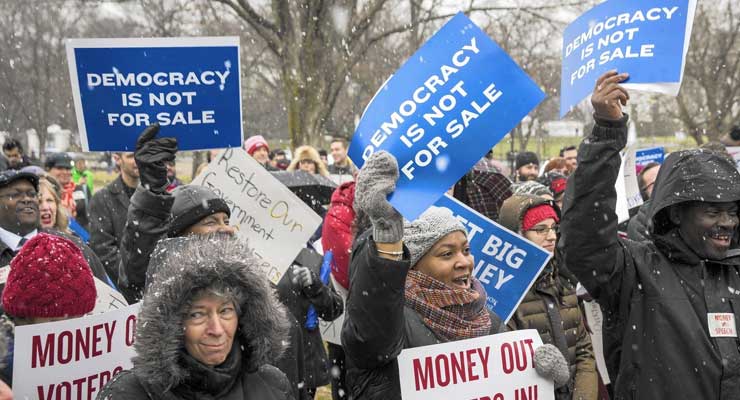
As the 2016 election cycle nears a close, there have been many topics that have been brought to the national spotlight that deserve to be talked about, from healthcare to foreign policy. But despite public opinion, a vitally important reform that needs to be addressed regards campaign finance. With only days to go, the money politics crisis has simply not been given the attention it deserves.
The issue of campaign finance also known as campaign lobbying, is one that is a polarizing topic that divides citizens among party lines. While Democrats are heavily in favor of limiting the amount of money that people can contribute to politicians, Republicans are largely against having the government say how much money can be contributed to campaigns over free speech concerns.
However, polarizing the subject maybe, citizens remain focused on reform. Limits on money politics have been brought to the forefront in four states this election cycle, giving voters the chance to define how much money politicians can receive.
The states of California, Missouri, South Dakota and Washington will have each see ballot referendums that will allow the voters to either limit the amount of money candidates can receive, or like in the case of California’s referendum, allow for the state’s delegates to overturn the 2010 Citizens United Supreme Court decision that allowed unlimited donations by corporations and unions.
“It breaks down to who has power”, Josh Silver of the advocacy group Represent.Us said of campaign finance. Silver founded Represent.Us in 2012 to help bring about change within the country’s campaign laws.
When it comes to the breakdown of these referendums, the degree to which the proposal attempts to limit money in politics goes back to the nature of polarization on the topic in each state. For the most part, if your state is a red or blue state on the electoral map determines the nature of regulations.
In the states involved with ballot referendums, California proposes the harshest attempt to limit campaign finance in Proposition 59, that could lead to congressional delegates overturning local impacts of the 2010 Citizens United decision. Washington state’s, proposition 735 would do the same thing.
In Republican leaning states, the attempt to limit campaign finance is a subject that lawmakers are much more reluctant to tackle as many believe that it shouldn’t be the government’s role to limit how much money should be allowed in politics.
Missouri, for example has multiple proposals that would limit the amount of money that can be donated to $2,500. This is significant for a state that leans heavily Republican – both the House of Representatives and the United States Senate are comfortably controlled by Republicans (116 Republicans in the house, along with 45 Democrats, and 24 Republicans in the Senate and 7 Democrats). Democrat Jay Nixon controls the Governor’s mansion.
According to the latest stats available, %0.4 of the super-rich donate “large sums” of money to political campaigns.
“I think we’re at a point in this country, if you look at how messed up it is, that moving reform at the city and state level, is literally the only solution, it’s the only viable solution”, Mr. Silver continued in his statement. Mr. Silver said referring to the inability to pass campaign finance reform at the national level in D.C.
In Republican dominated South Dakota, however, there are attempts to make changes to the state’s campaign finance laws, by implementing three major changes. The first requirement of South Dakota’s campaign finance reform law includes a plan to 1) create a public finance system, 2) Would lower contributions limits in the state and 3) Increase the state’s disclosure requirement.
According to a New York Times/ CBS poll, 84% of Americans think there is too much money in politics.
“I think there is too much money spent on campaigns and it ends up being lopsided”, said Sonja Rhodes, a Republican from Washington state. “They should pass a bill and instead of billions of dollars, spending should be limited to $10 million or so”.
The poll also showed that 46% say that we should completely rebuild the campaign finance structure, while, 39% say fundamental changes are needed, and 13% say only minor changes are needed
“I think it’s an obscene thing the Supreme Court did,” 67-year-old Terri Holland, a Democrat from New Mexico said regarding the 2010 Citizens United decision. The attitude reflects many Democrats feelings against the modern Supreme Court’s changes to money in politics. “The old boy system is kind of dead but now it’s the rich system. The rich decide what’s going to happen because the Supreme Court allows PACs to have civil rights.”
The attitude of Ms. Holland shows the beliefs of many Democrats, that the belief that the system is “rigged” by the wealthiest 1%. With the latest stats, available it is believed that it cost close $1 billion to run for President in 2012.
The “rigged” theme for Democrats was and has been played out during this election cycle with former Presidential candidate Bernie Sanders saying that the system is rigged for the billionaires and the top 1%.
In summary, the United States it remains vital to establish a system where by everyone who wants to run for political office should be able to and those who run for office don’t have to rely upon donations for office from places like corporations and or the super-rich. Will common sense prevail?
Links to Sources:
- Newsweek Link: https://www.newsweek.com/washington-south-dakota-campaign-finance-511396
- NCSL Link: https://www.ncsl.org/blog/2016/10/25/voters-in-four-states-to-decide-on-campaign-finance-issues.aspx
- New York Times Money in Politics Poll: https://www.nytimes.com/2015/06/03/us/politics/poll-shows-americans-favor-overhaul-of-campaign-financing.html?_r=1
Also see our main section about Money Politics!
Leave a Reply