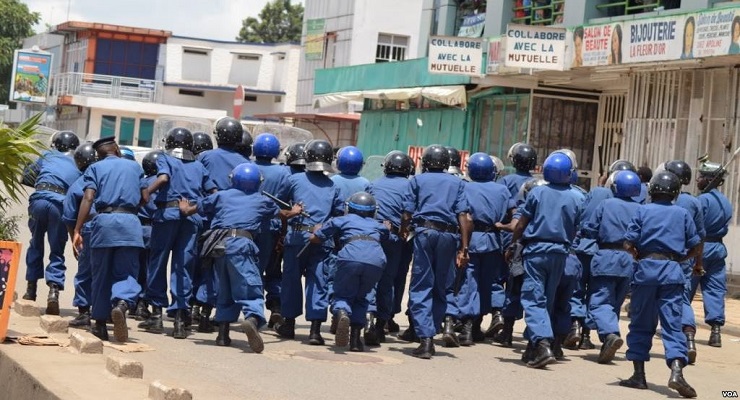

On 05 September 2018, the UN Commission of Inquiry on Burundi released a report that stated “more crimes against humanity were committed in Burundi in 2017 and 2018, whipped up by rhetoric from top officials including President Pierre Nkurunziza.” As reported in a recent Reuters article, Burundian authorities have treated the Commission’s report as “lies”. It was a typically tone deaf response in today’s Burundi.
The regime of Pierre Nkurunziza in Burundi’s capital, Bujumbura, predictably adopted this attitude towards the Commission’s findings and has refused to collaborate with investigators, even undertaking in a failed bid to stop its creation by the UN Human Rights Council back in 2015. So what is behind Bujumbura’s refusal to collaborate with the Commission?
The reason for this uncooperative behavior is because the mandate of the Commission and subsequently its findings and implications directly affect members of the Nkurunziza regime and the incumbent’s supporters. It is threatening not only the regime image but notably its survival. In a bid to ascertain this argument, this article will:
- look at the mandate of The Commission;
- find out the type and nature of the crimes committed;
- determine who the alleged perpetrators of the crimes reported by The Commission are;
- profile the victims (political and/or ethnic backgrounds);
- determine why these crimes are being committed.
The article uses desktop research for its findings. In its conclusion, it looks at possible sanctions on perpetrators, whoever they are and whatever their political affiliations, and establishes why the Nkurunziza regime would still be in place if its members, notably Nkurunziza himself, and supporters were involved in any crimes against humanity.
The mandate of The Commission
The Terms of Reference of The Commission show that it was created to investigate human rights violations committed in Burundi since the outbreak of the conflict in April 2015 that was triggered by Pierre Nkurunziza’s drive to change the rules barring a third term. The stated goals of The Commission are to fight impunity as well as identify alleged perpetrators of corruption in a bid to foster accountability.
The commission, furthermore, is required to “to formulate recommendations on steps to be taken with a view to guaranteeing that the authors of these violations and abuses, regardless of their affiliation, are held accountable for their acts.”
The Call for Submission, as found on the webpage of the UN Human Rights Commission dedicated to the Commision’s mandate, shows that to obtain information, “the Commission [invited] interested individuals, groups and organisations to submit information and/or documentation on human rights violations and abuses committed in Burundi since April 2015.”
Type and nature of crimes and perpetrators
The Report of the Commission (A/HRC/36/54) and (A/HRC/36/54/Corr.1), presented in Item 4, details various human rights accusations that require the attention of the thirty-sixth session of the Human Rights Council, 11-29 September 2017.
The summary of the report found on reliefweb stated that:
“The Commission can confirm the persistence of extrajudicial executions, arbitrary arrests and detentions, enforced disappearances, torture and cruel, inhuman or degrading treatment and sexual violence in Burundi since April 2015. Most of these violations were committed by members of the National Intelligence Service, the police, the army and the youth league of the ruling party, commonly known as the Imbonerakure. The Commission emphasizes the scope and the gravity of the documented violations, which, in some instances, entailed serious physical and psychological trauma for the victims. Human rights abuses were also committed by armed opposition groups, but these proved difficult to document.”
Victims of Political Violence in Burundi
The Immigration and Refugee Board of Canada stated in a 6 March 2017 report, found on refworld, that sources reported that the government targeted anyone opposing it during the initial stages of the uprising, notably the “third mandate opponents”.
The same report then indicated that despite there being a general crackdown when the violence started, the repression later evolved into an ethnic purge. It cited a source that stated that “political leaders [close to the regime] thought…they could use this instrument…to awaken former antagonist Tutsi-Hutu mobilizations that existed in the country and in the region, and that created thousands of victims.” In an article in Reuters on 04 July 2017, Aaron Ross noted that “Burundian authorities have intensified an ethnically-driven purge of the army…, risking renewed civil war in the central African nation.”
Conclusion
The summary of the Commission’s September 2017 report cited above and as found on reliefweb stated that there was “reasonable grounds to believe that crimes against humanity have been committed in Burundi since April 2015.”
The perpetrators are identified as individuals in the State apparatus and regime supporters. It seems the regime crackdown was initially meant to ensure the successful implementation of Nkurunziza’s third term bid but regime cronies might have used the conflict as an opportunity to seek retribution on Tutsi minority for decades of violent domination over the majority Hutu ethnic group.
The Mandate of The Commission requires that it names and shames perpetrators and makes recommendations for justice to be rendered. Therefore, we can see why the regime has decided it cannot be cooperative. The Commission’s findings are evidently a major risk to its survival.
The Commission itself, taking stock of this fact, stated that:
“Without a real willingness on the part of the Burundian authorities to combat impunity and guarantee the independence of the judiciary, the perpetrators of these crimes will remain unpunished. The Commission, therefore, requests the International Criminal Court [ICC] to initiate, as soon as possible, an investigation into the situation in Burundi since April 2015.”
However, as noted by Al Jazeera author Haru Mutasa, “Burundi became the first nation to withdraw from the ICC, partly in defiance of the international response the government crackdown after civil unrest and a coup attempt”. The ICC strategy would, therefore, seem to have little hope of producing results.
Coordinated international sanctions to strangle the dictatorship in Bujumbura could be the solution but may prove abortive without regional support. An article in The Economist has argued in this direction particularly in regard to Tanzania. Tanzania is a vitally important regional actor and played a critical role brokering the Arusha Accords key to bringing some peace in Burundi after years of instability. Unfortunately for Burundi, Tanzania is a country that is itself sliding into authoritarianism.
Nevertheless, when all is said and done, a concerted effort by the African Union can have some real impact. Cooperation towards international isolation, the freezing of assets, travel bans and embargos may be the only way forward.
Leave a Reply